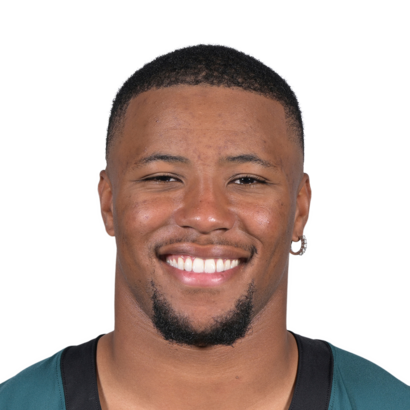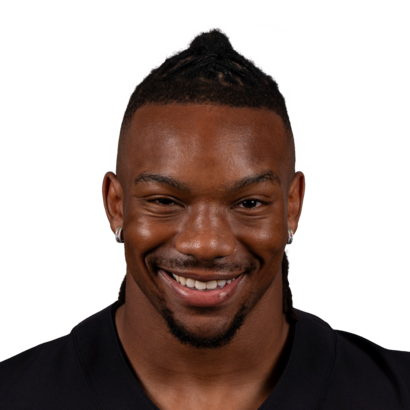
1.02 Draft Strategy In Fantasy Football For 2025: It's Saquon Barkley vs. Bijan Robinson
Chris Allen breaks down the ideal 2025 fantasy football draft strategy from the 1.02 draft slot, where you're goal is to start with one of Saquon Barkley or Bijan Robinson.
Regardless of the medium, I always gravitated more towards the sidekick than the hero.
Luigi was my guy in the original Super Mario Bros. game. Those white overalls were fire. I could make the case that Samwise Gamgee played a more critical role in the destruction of The Ring than Frodo. And, sure, Han Solo with a blaster was unbeatable. Just ask Greedo. But a wookie with a bowcaster? Yeah, I’ll choose him first.
I could go on (Frozone? C’mon.), but the intrigue for me was the same. The main attraction garnered the attention. While they would barge in guns (or lasers) ablaze, their trusty companion could take a beat, size up the situation, and slide in for the save. That’s essentially our opportunity when drafting from the 1.02.
The person in the one-slot has all the pressure. Everyone else, including you, is pushing for them to act. Meanwhile, the person in the second spot gets to wait and see how they can capitalize on the situation.
The 1.02 Debate In Fantasy Football Drafts
Luckily, the conversation of who to take second overall isn’t deep. Let’s assume the person drafting from the 1.01 took Ja’Marr Chase. We are left with only two options afterward.
Before I dive into the stats, let’s think about our choices from two different perspectives. First, they’re both bellcow RBs. In neutral situations, few saw more of their team’s carries. Plus, each earned double-digit target shares. On the surface, there’s no wrong answer here. But then there’s the roster construction aspect to consider.
By starting with a rusher, our options at receiver disappear before we can even celebrate our pick. Again, it’s not to say we made a wrong decision. However, each selection should inform the next. And even though the 1.01 took some of the pressure off us, things only get slightly easier from the two-hole.
Mama, there goes that man.
Barkley had 30 explosive runs throughout the regular season. You’d see something like the above almost twice a week. So, it’s no surprise to see the former Giants RB at the top of the expected points added chart for rushers. However, before the haters start to cheer, Barkley ranking fifth in success rate (which is more indicative of future production) should silence any notion that the Eagles’ offensive line was the driver. I mean, they certainly helped.
- Adjusted Yards Before Contact per Rush: 8th
- Run-Block Win Rate: 9th
However, I don’t think Lane Johnson was 20 yards downfield, ensuring Barkley hit the fourth- and fifth-fastest speeds of any ball carrier last year. Either way, the offensive infrastructure is still in place. There’s no added competition for targets, allowing him to get back to his 10.3% from last year. Father Time is our only concern. Now, contrast the stability in Philadelphia with the development we anticipate will occur about 750 miles southwest of there.
On the one hand, Bijan Robinson was one of eight RBs with over 60.0% of his team’s totes before Michael Penix took over. He even had a 13.6% target share. By our UR Score rankings, it’d be tough to find a runner with a better workload. However, that last clip is part of the origin of the excitement surrounding Robinson.
- Route Rate: 62.4% (w/ Kirk Cousins), 76.6% (w/ Penix)
- Receiving aDOT: -1.2, 4.0
Robinson went from 20.8 touches per game to 24.7 over his final three games with Penix. We saw less of Tyler Allgeier and more of the do-it-all workhorse we saw at Texas. And even though there was a wide gap in expectations for the Falcons as compared to the Eagles, it didn’t deter the 23-year-old RB from putting up similar metrics as the reigning OPOY. Robinson only had two fewer explosive plays, while boasting a higher success rate (55.6%). It’s easy to see how both can finish as top-three players at the position. So, let’s build around them.
- Multiverse 1: Saquon Barkley, Hero RB
- Multiverse 2: Bijan Robinson, Balanced
- Multiverse 3: Saquon Barkley, Robust RB
Because there were only two real players worthy of the second-overall pick, I added a draft strategy to go with them. The outcomes should help us understand how to create strong rosters despite differing build paths.
The Rest of the Early Rounds
Let’s do a quick review. I’ve got two primary objectives for the five remaining picks of the early rounds.
- Grab one QB or TE.
- Build starter power at the core positions.
Historical best-ball roster construction data has highlighted how important drafting at least one of the ‘onesie’ positions can be. But the power of our team lies in the RBs and WRs. Simply put, we start more of them. So, we need all of the good ones! It’s part of why strategies like LateRoundQB existed, as savvy managers knew they could build juggernauts early and tack on a viable passer later. However, it doesn’t stop old habits from resurfacing.

Three takeaways from the simulated mock data. First, eight WRs and nine RBs highlight my point about the diminishing talent at either position. Next, check the QBs featured in the second round. Their prices are a little aggressive, but you’d likely have to make the same decision by the thirties. Finally, if I wanted to employ a Hero RB build with Barkley as my anchor, I’d have some solid options available to me at the 23rd pick.

Admittedly, I’m cheating. I know my strategy without any intention of switching it. So, let’s say Josh Jacobs had been on the board still at the 2.11. I’d have let him go past. On the other hand, seeing Drake London available was an automatic click. I was able to build out the other two teams in a similar fashion.
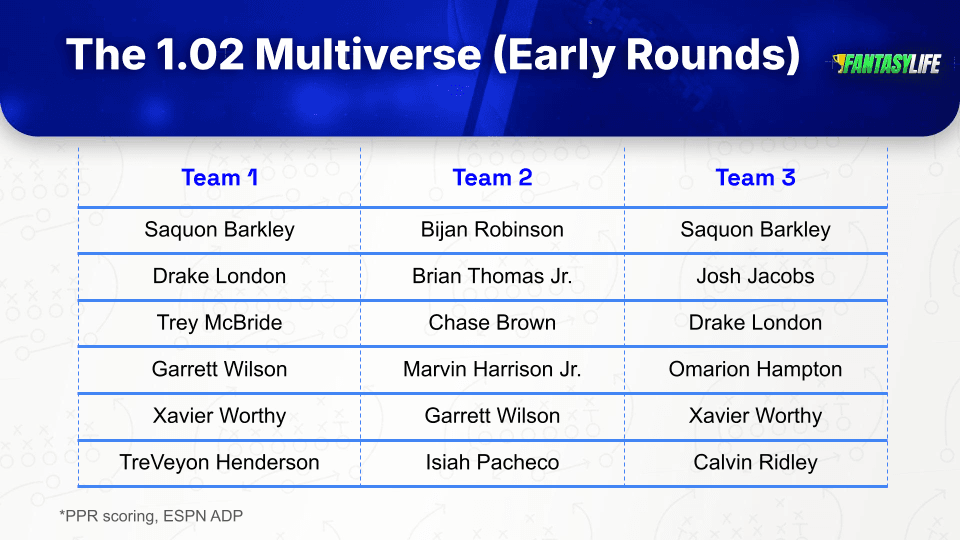
I’ll be honest. I’m not a fan of how the Hero RB build turned out. Sure, an RB duo of Barkley and TreVeyon Henderson might work out in the long run. But the Week 1 proposition of Henderson splitting time with Rhamondre Stevenson isn’t as easy a bet. And Garrett Wilson, as my WR2, with an unknown rapport with Justin Fields, doesn’t exude strength. Meanwhile, there’s some hope in the other universes.
I chose Wilson for the “Balanced” team as well to show how a build can change our perception. The Jets' WR1, as my WR3, curbs the uncertainty. Plus, I’ve got two other primary receivers to start alongside him. However, I was only able to accomplish one of my early-round objectives. Each roster has a strong core. I’d have to attack the onesies in the middle rounds.
Mid-Round Approach From The 1.02 Draft Position
Again, let’s look at strategic goals for Rounds 6-12.
- Assess roster needs.
- Address the onesies.
- Add depth.
It all sounds simple until you’re on the clock. But then again, drafting close to a turn gives you more time to think. For instance, let’s consider what Team 1 should prioritize.
- At least one more rusher to rotate in at RB2
- A starting QB and TE
- Depth at WR and RB
That first bullet stings. I probably should have grabbed my second RB in the fifth round instead of waiting until 71. But this is why taking stock of our squad as we go is vital. Each pick should inform our next. Accordingly, rushers with contingent value were high on my list. However, I also had to juggle tacking on WR depth. Luckily, I have an idea of what profiles to target.

Think about aDOT from a QB’s perspective. It’s harder for them to complete passes farther downfield. Consequently, it’s more difficult for receivers to catch the ball at similar depths. However, a high aDOT isn’t always bad. WRs averaging 13 or more air yards per target can still generate spike weeks for fantasy. Especially if they can earn other looks along the way. As a result, a guy like Rashid Shaheed becomes a tempting pick in the middle rounds.

I resent the C- grade from the mock draft simulator. Regardless, I got my guy. Also, I was able to harness the power of the turn. The team at the 1.01 had already selected a TE in the early rounds. I had no reason to think they’d take another, so I could push my preferred pick (Jake Ferguson) to the 11th round. At this stage of the draft, it didn’t have a huge impact, but making similar observations of your opponent’s team can help when building your own.
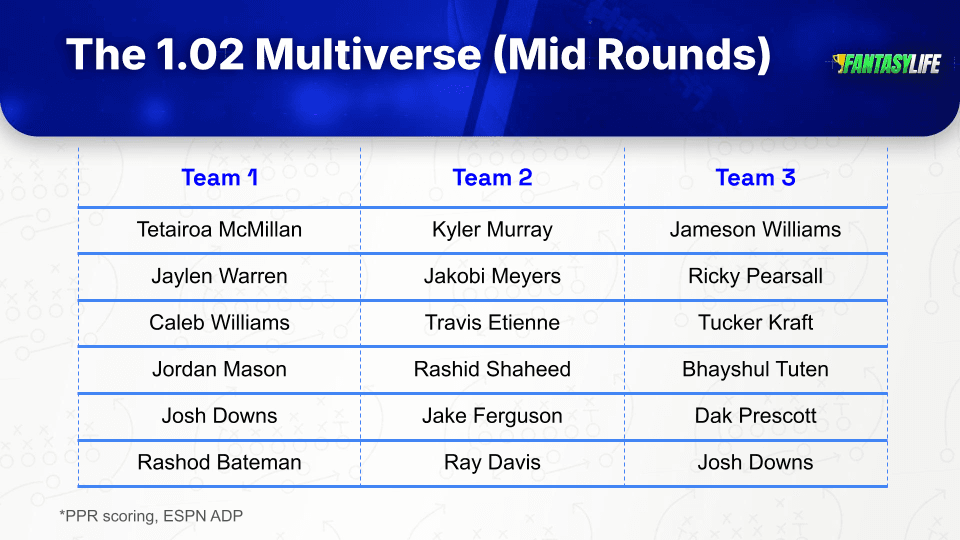
Team 1 was able to right the RB ship with Jaylen Warren and Jordan Mason. Both have weekly utility along with latent value, should the starter miss time. Teams 2 and 3 went with mid-round options at QB and TE as they fell. Neither had to sacrifice any opportunity cost to acquire them. Each has starters and bench players to cover the core positions. And while the names might not sway you, apply the same process with your favorite skill players in mind to construct a roster with the same potential to take down your league.

Join Our Newsletter
Trusted by 400,000+ fantasy football players. Get access to Fantasy Life's free award winning newsletter and tools, all in one step.
By registering or logging in, you agree to our Terms of Use and Privacy Policy.