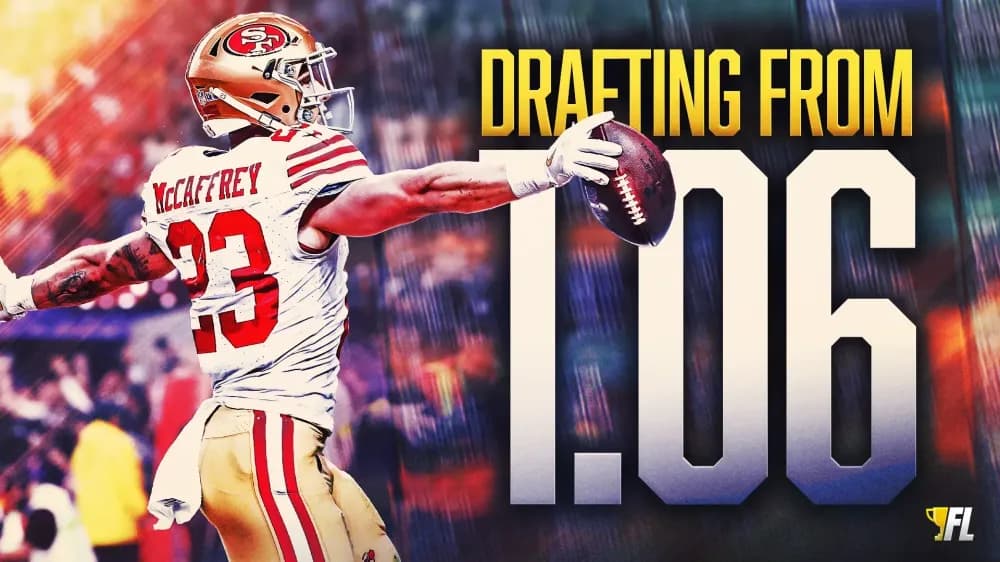
1.06 Draft Strategy For Fantasy Football 2025: Don't Shy Away From Christian McCaffrey
Chris Allen breaks down how to approach your 2025 fantasy football draft from the 1.06 draft position.
I love watching bad movies. Well, let me clarify “bad.”
My brother-in-law and I were talking about Final Destination Bloodlines. From everything I’ve heard, it’s good. No, it doesn’t redefine horror flicks. I haven’t checked the box office numbers, but I doubt it made a billion dollars. So, “good” is a relative qualifier.
I know what I’m getting into with a movie like Final Destination. Give me about 100 minutes of a thin plot loosely held together by elaborate death scenes, and I’ll be in the front row. Again, I’ve set my expectations based on prior history. Any callbacks or easter eggs are a bonus.
The 1.06 carries a similar vibe. We might be halfway through the first round, but the options feel even further away. Less secure. In other words, good. However, without knowing what to expect, it’ll be harder to construct a viable roster.
Test the 1.06 and any other draft position for free with our Mock Draft Simulator in Draft Champion!
The 1.06 Debate in 2025 Fantasy Football Drafts
Think about the six-spot in previous years. Travis Kelce held it just a couple of years ago. We took on more risk after just five picks. Unsurprisingly, the players in contention for the 1.06 don’t make the decision any easier.
Yes, I realize we only had Christian McCaffrey for a few weeks. But let’s look at his workload over that stretch.
- Rushing Share: 68.3%, 9th (out of 23 qualifying RBs – min. 50.0% team rushing share)
- Red-Zone Rushing Share: 100.0%, T-1st
- Target Share: 18.2%, 3rd
The 49ers didn’t waste any time bringing their RB1 back into the fold. But McCaffrey’s 10-week absence, bookended by shaky reports of his availability leading into the season and a PCL injury, doesn’t boost our confidence in the 29-year-old rusher. However, San Francisco’s actions should give us some hope.
Jordan Mason, McCaffrey’s primary backup, is in Minnesota backing up Aaron Jones. McCaffrey’s current competition, Isaac Guerendo and Jordan James, are Day 3 picks. Brandon Aiyuk’s availability, or potential lack thereof, aside, it’s hard to envision an efficient Brock Purdy-led passing game without McCaffrey. A high-end workload is already in the projections for him. His health, short- or long-term, will be the constant question. So, your risk tolerance becomes a factor. Anyone looking to draft Puka Nacua will have a similar debate.
I don’t know about you, but a 37-year-old QB with multiple back injuries on his resume, missing vital time due to soreness in the same area, gives me pause. On top of Matthew Stafford’s penchant for looking Nacua’s way, the quality of targets had the sophomore WR on an elite trajectory.
- Target Share (Weeks 10-17): 38.5%, 1st (out of 35 qualifying WRs – min. 20.0% target share)
- Yards per Route Run: 3.77, 1st
- YAC per Reception: 6.5, 6th
Davante Adams doesn’t worry me. Stafford was able to support Cooper Kupp and Nacua in their heyday. The Rams’ offense has been the concentrated type we can rely on for fantasy production. But the more Stafford rests, the more the security of Amon-Ra St. Brown’s role may sway drafters. Malik Nabers showed enough in his rookie year that a season of Russell Wilson and (maybe) Jaxson Dart might be worth the click. So, let’s see if we can work around the uncertainty.
- Multiverse 1: Christian McCaffrey, Hero RB
- Multiverse 2: Puka Nacua, Balanced
- Multiverse 3: Christian McCaffrey, Robust RB
Admittedly, evaluating the McCaffrey teams will be subjective. But I wanted to look at drafting him from two perspectives: risk-averse or lingering doubt. Of course, the obvious option is to avoid him. But if you take the plunge and swing for the fences, let’s work through how we can construct a solid squad around him.
The Rest of the Early Rounds From The 1.06 Draft Position
I’ll harp on my early-round objectives once again, but I’ve got a special adjustment for Team 1.
- Grab one QB or TE.
- Build starter power at the core positions.
We’ve already identified McCaffrey as a high-risk asset. However, with a Hero RB approach, we’re assuming the best case for him. A full season of health. The rushing and passing volume we’ve seen in past years. Accordingly, we should treat our subsequent picks like we have Saquon Barkley, Bijan Robinson, or Jahmyr Gibbs on our team. Heck, let’s spice it up even more with a correlated bet. I’ll give you an example.

First of all, I disagree with what grade the Draft Champion tool gave me for my 43rd and 54th selections. Anyway, you can see how this plays out. Patrick Mahomes stages a “comeback” as a fantasy passer. He’s been trying to get the deep ball back into the offense. Xavier Worthy has both the speed and lack of a looming suspension to be the primary beneficiary should explosives find their way back to Kansas City. So, assuming I’m right about McCaffrey, now I have another ace up my sleeve. However, if you don’t like this duo, there are other (better?) duos you could swap out for the Chiefs’ QB-WR1.
- Jalen Hurts (ADP: 29.7), DeVonta Smith (74.9)
- Tee Higgins (29.3), Joe Burrow (34.3)
- Jayden Daniels (27.2), Terry McLaurin (46.6)
Stacking isn’t as prevalent in managed leagues as best ball formats due to the week-to-week reliance in redraft. However, by linking a QB and their top receiver, we’re amplifying the correlation. Said another way, we have no concern about Smith, Higgins, and McLaurin’s (assuming Washington’s front office comes to their senses) weekly target share. But now, we get to share in the bonus of them falling into the end zone.
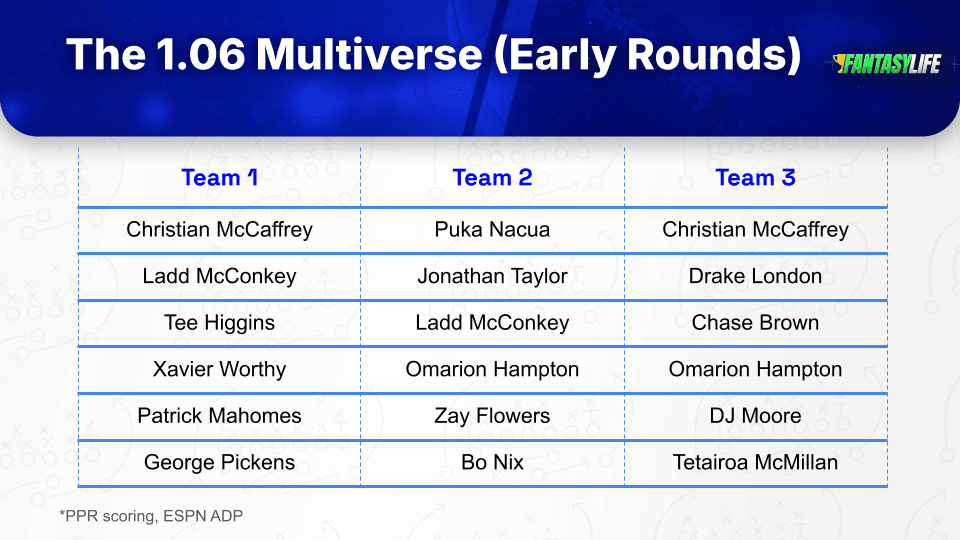
I know I’m going to sound biased here, but c’mon. Look at Team 1 and compare it to Team 3.
No, I didn’t do it intentionally.
It’s why I’ve discussed the concept of opportunity cost in the past. By trying to “shore up” my RB stable, I had Drake London as my only WR by the fourth round. And the remaining alternatives weren’t getting any better. Instead of leveraging McCaffrey as a possible strength, my team has multiple needs heading into the middle rounds. Meanwhile, Team 1 has fewer gaps (on paper) that I could address in the next phase of the draft.
Mid-Round Approach From The 1.06 In Fantasy Drafts
Remember the “You Got Detention” PSA by Captain America from Spider-Man: Homecoming? I’ll riff off of it here.
*sits in chair backwards*
(Steve Rogers voice)
So, you tried to hide the risk of drafting Christian McCaffrey by drafting a bunch of early-round RBs, and now you’re playing catch-up with your leaguemates.
You feel stuck. All thoughts of a plan go out the window. The clock runs out while you’re scrambling to make a decision, and you plead with the commissioner that your internet went out for a second. It happens. But again, I’ll borrow from our best ball brethren to highlight one of the strengths of drafting from the 1.06.

Hayden Winks emphasized how reaching for a player can impact your team’s output. The farther we extend into the next round to acquire “our guy,” the greater the hit. However, the six-spot gives us some level of insulation from straying far from the optimal path.
- 1.01 – 22 (players in between picks)
- 1.03 - 18
- 1.06 - 12
I’ll use an extreme scenario to explain. Let’s say I’m an Eagles fan. When drafting from the 1.01, there’s no chance I’ll be able to get A.J. Brown on my team. His ADP is 17.8. He’s not going to be there at 24 overall. Consequently, if I want him, I’d have to take him first. Say goodbye to Ja’Marr Chase, CeeDee Lamb, and Justin Jefferson. Arthur Juan is coming to town. But drafting from the middle gives us some wiggle room. There are only four other WRs ahead of him in the ranks. Their situations aren’t clear upgrades over Brown’s. In other words, the effect won’t be the sole reason for missing the playoffs. So, we can pull players up to match our needs. Two WRs stuck out in the ninth and tenth.
- Jayden Reed – shown high efficiency on limited volume; could have a larger role this season
- Christian Kirk – earned high volume in previous offenses; fills a position of need in Houston
After running through multiple draft simulations, I took both WRs no more than ten picks ahead of where the bots tried to snag them. Plus, their situations have the added potential benefit of outperforming their draft costs. However, I still had a QB problem. Luckily, there was at least one passer with a few traits working in his favor still on the board.
Drake Maye already showcased his scrambling ability as a rookie. After he took over in Week 6, only Jayden Daniels bolted out of the pocket more often. Even better, Maye racked up the most rushing yards of any QB as a scrambler. But we need the passing production, too. Coincidentally, he showed us some of that as well.

Completion percentage over expected is like grading on a curve. If you complete more difficult throws, you get more credit. Surprisingly, Maye posted a higher CPOE than Mahomes despite having the following options for most of the year:
None of whom has ever had a 1,000-yard season. And let’s set aside the fact that Maye was seeing pressure at the 12th-highest rate. He was making it work then, and now he has at least one more target and better protection. Regardless, by navigating through the ADPs, I was able to have my entire roster set before dropping in a QB and TE to round out the team.
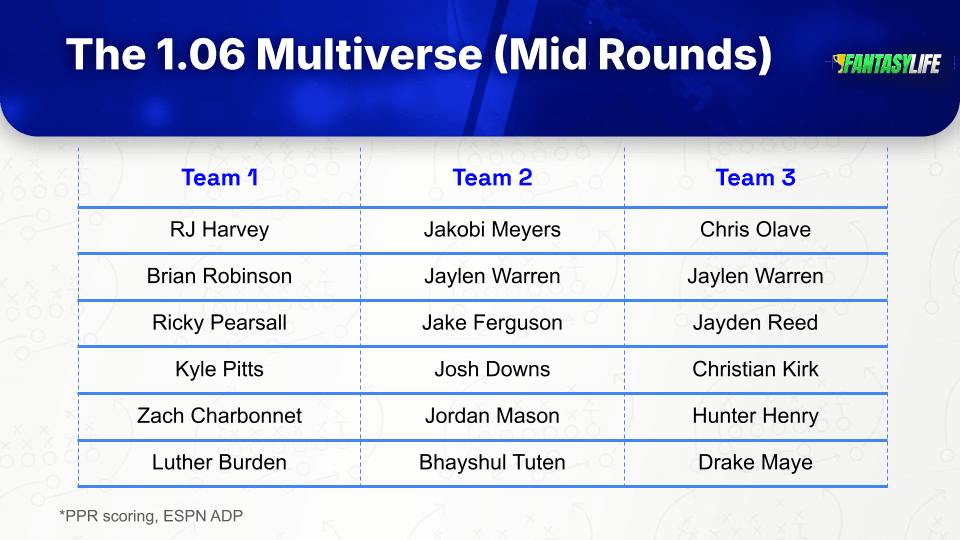
Team 1 has the ceiling to take down any league. It’s the three-leg parlay of the season.
- Can McCaffrey stay healthy and maintain his 2023 efficiency?
- Will Patrick Mahomes find his deep ball?
- Is Kyle Pitts ever going to show us something other than what he did in his rookie season?
Draft boards would flip if we knew the answers to those questions. Meanwhile, all Team 2 has to worry about is Stafford’s back. But the process to evaluate each roster is the same. Finding the gaps and leaving yourself with fewer questions (or greater upside) should be the goal of any drafter. And based on your risk tolerance, you’ll wind up with something that looks like either of the first two rosters when drafting from the middle of the pack.

Join Our Newsletter
Trusted by 400,000+ fantasy football players. Get access to Fantasy Life's free award winning newsletter and tools, all in one step.
By registering or logging in, you agree to our Terms of Use and Privacy Policy.