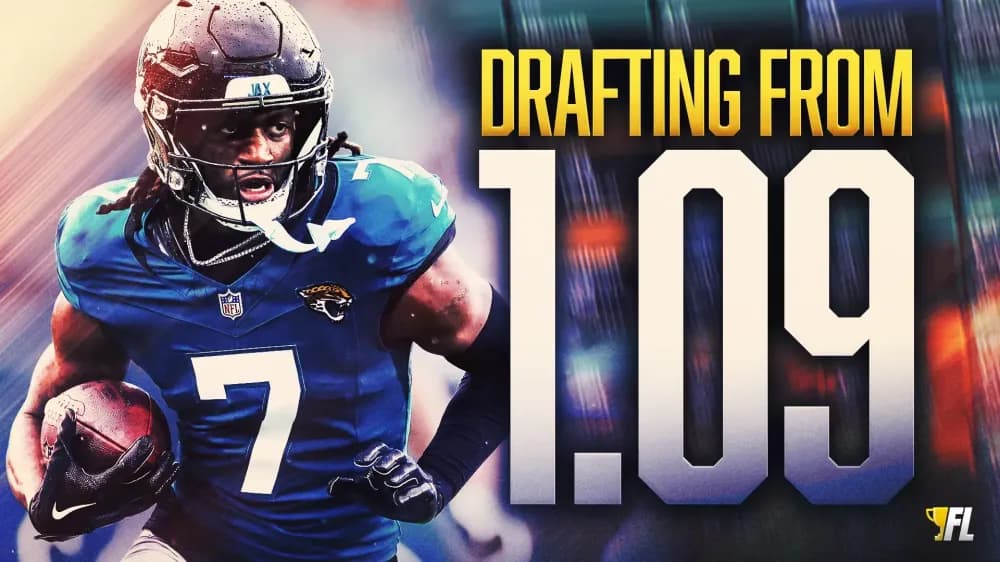
1.09 Draft Strategy for Fantasy Football 2025: Brian Thomas And A Jazzy Collection Of Talent
Chris Allen makes music with his perspective on the 1.09 spot in fantasy football drafts, choosing players like Brian Thomas, Nico Collins, and others.
“It’s not the note you play that’s the wrong note— it’s the note you play afterwards that makes it right or wrong.”
Miles Davis knew music like few others. He recognized that a song was a river of riffs and melodies all flowing together. It can change direction or tempo at the drop of a dime. Regardless, we shouldn’t evaluate a song on a single sound, but by the ensemble.
The 1.09 can feel like you’re in a jazz band. You’re having to play in tune with the eight drafters. However, the first-round options don’t feel as exciting. Even worse, you’ll make your first pick and think you’ve already made a mistake. But, as Miles Davis said, it’s that second action you should really be thinking about.
For access to our premium tools, use the promo code ALLEN and you will receive 20% off your subscription.
The 1.09 Debate (aka The 1.08 Debate Part II)
Unfortunately, you’ve got two issues if you get dealt the nine spot. First, as I laid out in the intro, the available talent doesn’t compare to what your leaguemates already have on their rosters. They each have their warts. And, just by looking at the names, the 1.09 feels somewhat similar to the 1.08.

Admittedly, I use the ‘Provider’ filter on our ADP tool to focus on ESPN’s draft prices often. So, it’d make sense to see the same set of WRs I listed as potential targets for the 1.08 still on the board for the ninth-overall pick. But OK, let’s try Yahoo.

The cluster of Malik Nabers, Nico Collins, Amon-Ra St. Brown, and Brian Thomas remains. You can change the order however you want, but you can’t escape seeing their names climb to the top of the queue. FFPC can have higher-stakes leagues. Maybe money might shift people’s thoughts.

Funnily enough, the TE premium scoring on FFPC moves a guy like Trey McBride into the first round. You’ll never guess who typically sits at pick 17: Brian Thomas.
So, it’s the same list of WRs we litigated at the eight spot. They’re all in the same tier, per our ranks. Said another way, their outcomes are relatively similar. Only six points separate the four in Dwain’s half-PPR projections. Let’s compare them to the guys we likely wouldn’t see at the 1.09.
- Ja'Marr Chase: 266.0 (projected 0.5-PPR points)
- CeeDee Lamb: 256.8
- Justin Jefferson: 236.1
Look at the drop-off from Ja’Marr Chase to Justin Jefferson. A 30-point gap exists between the two receivers commonly drafted in the first six picks. Meanwhile, we’re quibbling over a delta of six points just a few spots later. In other words, the similarities at our end of the board should make our decision easier. And, critically, they should have us thinking about the second round as soon as we make our first click.
- Multiverse 1: Malik Nabers, Nico Collins
- Multiverse 2: Amon-Ra St. Brown, Derrick Henry
- Multiverse 3: De'Von Achane, Brian Thomas
Remember, the first note isn’t the wrong one. It’s how you respond the next time. Sure, the WRs don’t offer the same upside as the top guys. But you can build on your strengths in the second round. In the end, you’ll find yourself in a better position than the folks with a top-4 slot.
The Rest of the Early Rounds
Let’s stick with Team 1 for a bit. I’ve outlined them before, but I have two loose guardrails for the early rounds.
- Grab one QB or TE.
- Build starter power at the core positions.
A WR-WR start comes with an inherent drawback. You’re foregoing an RB until at least the third round. Now, add in the context of your draft slot. The pairing of Nabers and Collins doesn’t hold the same value as a duo of Lamb and Drake London. Essentially, you’re already playing from behind. And, to put even more pressure on you, the stretch from the 2.05 to the 3.08 removes a lot of high-end talent from the board.

Admittedly, I’d panic. The lack of access to rushers with pass-catching viability is glaring. However, let’s take a look at our options.

The nine rushers on the chart have ADPs from the back half of the third round to the end of the sixth round. Put another way, one of these guys will be Team 1’s RB1. However, I’ll use the group to paint a broad picture.
I purposefully left out their draft prices to highlight their point totals. Only two (literally) stick out. The rest have a likeness to them. Add in their situational context, and they all have a case.
Kenneth Walker III might excel in OC Klint Kubiak’s blocking scheme. James Conner could maintain his workhorse role in an improved Cardinals offense. Like our WR decision in the first round, the interchangeability around the RBs in this range provides some levity. We can secure a viable floor of touches at multiple points throughout the early rounds. Accordingly, our roster can benefit from boosting our advantage at other positions.

Instead of reacting to the dwindling RB options, I took a detour and grabbed Jalen Hurts. I gave my QB slot an elite starter while acknowledging the decline in available rushers. However, to mitigate relying on just Walker, a player like TreVeyon Henderson, with a path to more touches as a rusher and receiver, bolsters my rushing stable. So, by taking the long view, you can work around starts that leave your team looking imbalanced after a few picks.
Mid-Round Approach
The middle rounds are where we should be assessing and re-assessing our teams. Identify our gaps. Find players at a reasonable cost to fill them. Team 3 had a few to consider.
- Draft a QB
- Add a rotational RB2 and depth
- Add a rotational WR2 and WR3
There’s no issue with Brian Thomas as a WR1. However, the Cardinals are still pinning Marvin Harrison Jr. to the outside as a sacrificial X receiver. DJ Moore still has multiple players to compete with for targets in a newly schemed offense. Either could be a liability once we’re into the season. So, finding receivers with evolving usage is worth the investment at this stage of the draft. Seeing how their teams deploy them is one way to do this.

Receiving aDOT is an indicator of the types of routes a WR can run. Plus, the higher the aDOT, the more challenging the targets will be. We want layup throws to the short area of the field. A receiver’s reception rate has a mild correlation to how far down the field they typically run. And, of course, more catches mean more points. Luckily, two WRs with receding aDOTs were available in the middle rounds.
- Jameson Williams: 19.3 (2022 aDOT), 16.0 (2023 aDOT), 11.6 (2024 aDOT)
- Chris Olave: 14.9, 13.9, 10.6
Both come with some uncertainty. Williams returns to a Lions’ passing game without their progressive playcaller and multiple offensive linemen. Chris Olave will be catching passes from either Tyler Shough or Spencer Rattler. However, if both WRs can maintain their historical target shares but at shallower depths, their production improves, enabling more options to start on a weekly basis.

Unfortunately, Team 2 wins. From this position, integrating a balanced approach from the 1.09 netted two strong rushers and a high-end TE without sacrificing opportunity cost. And by identifying QB as a need in the middle rounds, the Dak Prescott selection rounds out the build.
However, as I’ve often preached, the names aren’t important until we’re on the clock and click them. Understanding our roster needs and the types of players available carries more value. They’re what will guide us to the players. And from there, a championship.

Get $25 Guillotine League Credits When You Join FL+
Lorem ipsum dolor sit amet, consectetur adipiscing elit. Nunc tinciedunt, ex sit amet cursus gravida, dui mauris vulputate felis.