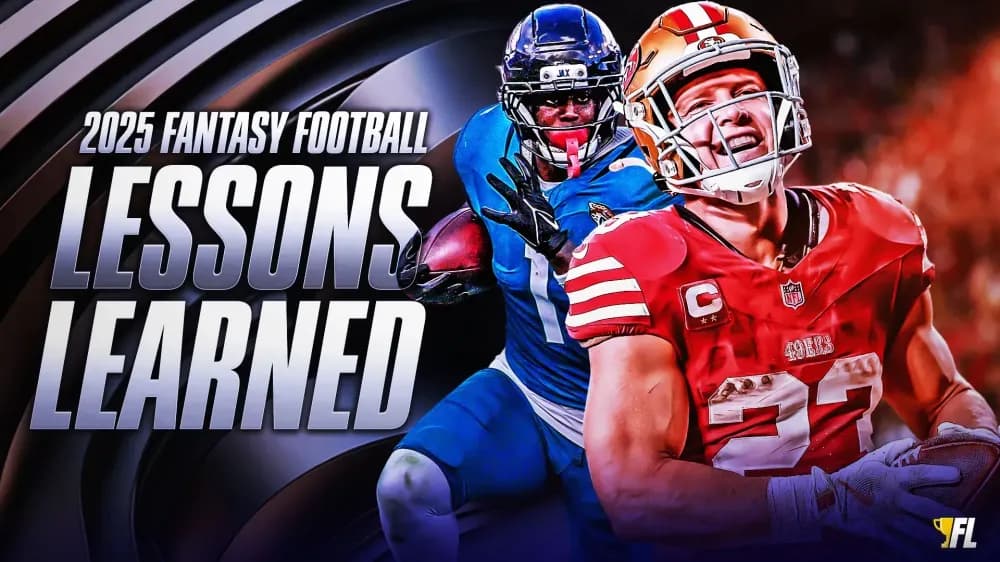
Six Lessons We Learned From The 2025 Fantasy Football Season
Ian Hartitz recaps the biggest lessons we learned from the 2025 fantasy football season.
We laughed. We cried. We won. We lost.
But through it all, we had fun. Right? RIGHT?!
Regardless of whether you won your fantasy league or captured the dreaded last-place punishment, the clock is ticking to get ready for 2026, where we will once again attempt to capture bragging rights over friends, family and/or internet strangers by winning a fantasy football championship.
This brings us to today's goal: Six lessons I learned from the 2026 fantasy season.
As always: It's a great day to be great.
Lesson No. 1: Old, boring veteran RBs can still put up good fantasy numbers
This has always been true at QB, while RBs have usually peaked in the 22-27 range, and WRs/TEs more so in their mid-to-late 20s.
But not always. Rookie fever tends to capture the imagination of the fantasy community on an annual basis, and hey, that's cool. It's important to be on the up-and-up with knowing as much as we can about the new, shiny fantasy assets.
Of course, sometimes folks go a bit too far in their belief in these year one players—particularly those without marquee draft capital. The hit rate of day-three talents is VERY minimal both overall and during rookie seasons, yet the following 2026 ballers were largely expected to lose their job to their team's respective new late-round RB.
- Jaguars RB Travis Etienne: RB12 in PPR points per game, RB37 in preseason ADP
- Cowboys RB Javonte Williams: RB13 per game, RB43 ADP
- Bears RB D'Andre Swift: RB15 per game, RB25 ADP
Now, there are exceptions to this rule—Giants RB Cam Skattebo carried Round 4 draft capital and looked a lot like what the kids would call a league-winner before suffering an unfortunate season-ending ankle injury—but hell, even guys with day one and two draft capital like Omarion Hampton, RJ Harvey, TreVeyon Henderson and (especially) Kaleb Johnson faced far steeper competition from their team's veteran options than expected.
Be sure to think twice before automatically fading the Week 1 starting RB inside a good offense at a low cost just because of a newfound threat that may or may not actually be, you know, good at football.

Go FantasyLife+
Your league is unique. Your advice should be too. Get personalized tools, rankings, and projections tailored to your fantasy football league settings.
Lesson No. 2: The late-round dual-threat QB remains king
There has been a late-round ADP with relatively proven dual-threat upside that has smashed in fantasy during basically each of the last seven seasons.
- 2019: Lamar Jackson (QB1 in fantasy points per game, QB15 ESPN ADP
- 2020: Josh Allen (QB2 per game, QB8 ADP)
- 2021: Jalen Hurts (QB6 per game, QB11 ADP)
- 2022: Justin Fields (QB5 per game, QB18 ADP)
- 2023: Anthony Richardson (injured, QB16 ADP)
- 2024: Jayden Daniels (QB6 per game, QB12 ADP)
- 2025: Drake Maye (QB3 per game, QB16 ADP)
Trevor Lawrence (QB6 per game, QB20 ADP) also returned rather awesome value on the back of nine (!) rushing scores. Hell, even Daniel Jones and Jaxson Dart vastly exceeded 2025 expectations relative to their basically non-existent ADPs.
Dual-threat passers and receiving-friendly RBs continue to be the closest things that the great American pastime known as fantasy football has to cheat codes. It'd behoove all of us to continue investing in each—particularly when they aren't even all that expensive to acquire in the first place.
Lesson No. 3: We probably shouldn't ignore late-round WRs with the potential to earn a shit ton of targets
Ah, yes: A Wan'Dale Robinson lesson.
Look, obviously Robinson benefited from Malik Nabers' (ACL) unfortunate season-ending injury, but WR33 and WR5 finishes in Weeks 1 and 2 reflect the reality that the pint-sized slot maven was already doing plenty to beat a consensus WR67 ADP.
Now, personally, I had issues with Robinson's hilariously miserable 2024 efficiency, but there was still the simple reality that we were looking at one of the very few cheap WRs with a quality target projection. In fact, at the end of July, Robinson stood out as one of just seven WRs priced outside the position's top 45 with a Fantasy Life target projection north of 90.
- Wan'Dale Robinson (WR15 in PPR points per game per game, WR67 ADP)
- Michael Pittman (WR23 per game, WR47 ADP)
- Quentin Johnston (WR25 per game, WR69 ADP)
- Rashid Shaheed (WR49 per game, WR53 ADP)
- Hollywood Brown (WR51 per game, WR60 ADP)
- Cedric Tillman (WR88 per game, WR63 ADP)
Not all hits, but three pretty awesome ones, and this does raise the point that IF you are going to throw a late-round dart at the WR position, why not do so with a player expected to earn a lot of targets!
Lesson No. 4: Paying a premium on a pure handcuff RB without a clear path to taking over the starting job doesn't make a lot of sense
This doesn't apply to guys like Tyler Allgeier or Blake Corum, who were usually available well outside of the top-10 rounds during any given draft. Rather, the bigger issue revolves around the likes of David Montgomery, Jordan Mason and Zach Charbonnet, who were being drafted inside of the top 100 despite needing an injury to their backfield mate to reach an elite runout.
And hey, maybe some of this is hindsight. Montgomery was pretty great alongside Jahmyr Gibbs in 2023 and 2024, while Charbonnet did manage to score 11 TDs this season on his way to a fine enough RB30 finish. Mason put forward some pretty great efficiency numbers (RB9 in rush yards over expected per carry) and, more so, was a victim of the Vikings' unsteady (to be nice) QB room more than anything.
But still: What was really the allure here? The best-case injury-induced upside wasn't all that much more appealing than the Allgeier-Corum types available rounds later, and even hitting peak non-injury runouts wasn't exactly producing anything close to must-start RB1 types. Again, it's easier to see the holes in these profiles with the benefit of hindsight, but legit league-winning WRs like George Pickens and Chris Olave were still on the board in this range, as were definitive starters like Jaylen Warren, Travis Etienne and Javonte Williams, among others.
There's a place for handcuff RBs in fantasy football land—but generally it's probably a good idea for that place to be behind legit upside WR3s and starting RBs.
Lesson No. 5: Don't fade someone simply because "they'll get hurt"
This mostly applies to olds who have made fantasy managers go through some injury-induced heartbreak over the years. And yet, guys like Christian McCaffrey, Derrick Henry, Davante Adams (for a large portion of the season) and (to a lesser extent) Stefon Diggs still managed to provide plenty of fireworks despite being a bit longer in the tooth than their peers.
Of course, guys like Tyreek Hill and James Conner were forced to spend the majority of 2025 on the sideline, but that's the weird thing about injury talk in fantasy football: When Hill and Conner get hurt, that's because they're old, but Malik Nabers and Bucky Irving? Well, that's just bad luck!
There's certainly something to be said about aging players ACTIVELY dealing with preseason injuries, but if not? Don't be afraid to buy the dip for a longtime great player still in a good situation who is only as cheap as they are … because surely they'll get hurt at some point.
Lesson No. 6: Follow the schedule for a last-round DST
This helped us land on the Patriots and 49ers as our preferred last-round DSTs. Obviously, the latter was decimated by key injuries across the front-seven, but the former returned legit top-eight production at a lowly DST21 ADP thanks in large part to a schedule that looked soft back in August … and it was!
Sometimes drafts fall in a manner where you can get the Texans and Broncos of the world in the final two rounds without having to worry about reaching. But if not? Follow the schedule and don't be afraid to play the waiver wire game—the position is volatile and tough enough to predict as it is; there's no need to go out of your way to spend draft capital when legit skill-position options are still on the board.

Join Our Newsletter
Trusted by 400,000+ fantasy football players. Get access to Fantasy Life's free award winning newsletter and tools, all in one step.
By registering or logging in, you agree to our Terms of Use and Privacy Policy.