The Trade Analyzer: Crafting an A.J. Brown Deal, Paying Up For Zay Flowers and More
In the latest Trade Analyzer, Chris Allen works out a figurative A.J. Brown deal, reveals the most traded players on CBS, and more!
Here’s how I know I have a problem with my Bengals’ fandom.
True story. I’m sitting in a conference room at Tinker AFB, a week before the season opener. My phone starts buzzing multiple times. I check and see the news of Micah Parsons’ trade to Green Bay. Of course, my knee-jerk reaction was shock. Then, I saw the terms, and a single question went through my mind:
Why couldn’t Cincinnati have offered that?!
The (sad) reality of the Bengals’ front office aside, we have similar reactions to trades in our own leagues. Prices we never would’ve fathomed until they show up in the group chat. So, with emotions running high after Week 1, let’s think through a few...
Potential Trade Targets
Each week, I’ll start with a few targets worth trying to acquire in a trade.
Sure, scoff at the ‘Buy Low’ options. However, you don’t know how each manager feels about the players on their roster. Especially ones that likely contributed to their first loss of the year. Or, they might not have full confidence that what happened in Week 1 is representative of the regular season. In other words, the uncertainty is our opportunity. And after some of the performances, there might be a buying window.
Buy Lows
- A.J. Brown – Didn’t see a target until less than two minutes remaining in a game with just four points separating the teams; Hurts’ 35.0% throw rate to WRs was a career-low, indicating a potential structural shift in the offense.
- Tyreek Hill – Sat below a 20.0% target share in a passing game featuring an injured Jaylen Waddle, Malik Washington, and Tanner Conner. Tua Tagovailoa’s increased average time to throw points to an inability to execute the offense as designed.
- RJ Harvey – The clear backup to JK Dobbins. Only earned seven touches to the veteran’s 18 and didn’t have a defined role (no two-minute snaps, mixed in obvious passing situations, etc.).
I just laid out the case for why each player is at least worth asking for a price check. But the benefit to your squad also has to be there. A.J. Brown was dealing with a hamstring injury only two weeks ago. Tagovailoa isn’t the first QB to fall flat against DC Lou Anarumo. Harvey is a rookie (and wasn’t the only thing wrong with Denver’s offense on Sunday).
Essentially, there’s a (semi-visible) path to production for each of them. But some of Week 1’s top performers, we don’t have to conduct the same thought exercise.
Buy Highs
- De’Von Achane – Earned a 13.0% target share to go with hoarding 70.0% of the RB totes; he only had two games in ’24 with a carry rate above 70.0%
- Garrett Wilson – Amassed a hilarious 44.0% target share; Justin Fields looked like a competent passer under new OC Tanner Engstrand
- Zay Flowers – Hoarded 50.0% of Lamar Jackson’s targets; just his tenth time earning nine or more targets in a single game
On the flipside, there has to be some skepticism on the part of your trading partner fueling the need for a trade (what they obviously view as a traditional sell high). I already noted the vibes in Miami. After multiple seasons of inconsistency, declaring Fields a top-end passer should be a stretch for anyone. And we can’t expect Mark Andrews’ absence to continue, to say nothing about what the Ravens’ aerial attack will look like when Isaiah Likely rejoins the flock.
In a sense, you’re taking on the risk for your leaguemate. However, of course, it comes at a cost.
Finding the Right Value
One of the perks of working here is that I get to play with all of the tools the Fantasy Life crew develops. The Trade Analyzer is now one of my favorites. On top of comparing the players using our rankings and projections, it’ll even integrate Dwain’s UR Score (presented by DraftKings) into the detailed player analysis. All you have to do is sync your league to the site to start finding viable deals. Coincidentally, I have Zay Flowers on a squad and wanted to see what I could get in return.
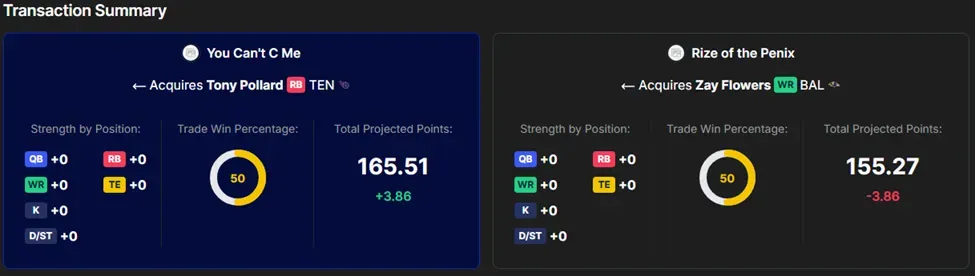
After a rough outing against Denver, I’m not excited to pick up Tony Pollard. However, he did post a top-24 UR Score (68, 22nd), pointing to better days ahead with similar usage. In either case, understanding the range of RBs to target (Omarion Hampton and Aaron Jones are next to Pollard in UR Score) narrows my focus. Plus, the tool identifies the fallout to my roster should I make a comparable deal:
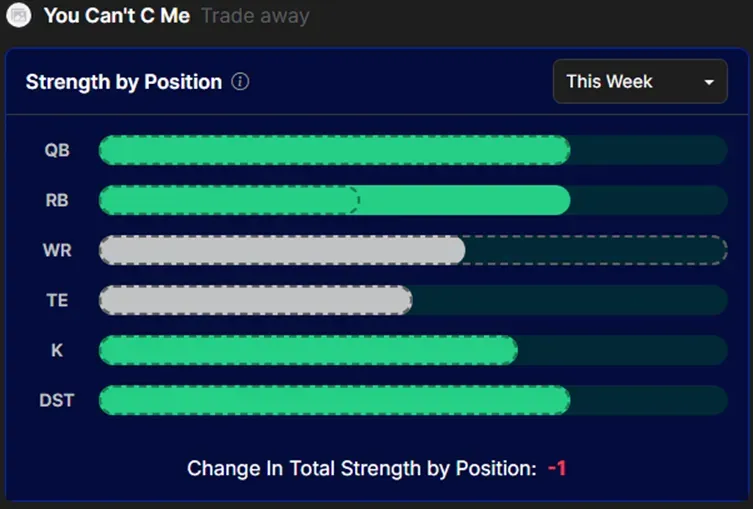
Meanwhile, if I want to buy low, I’ll need to get a little creative with the deal's elements.
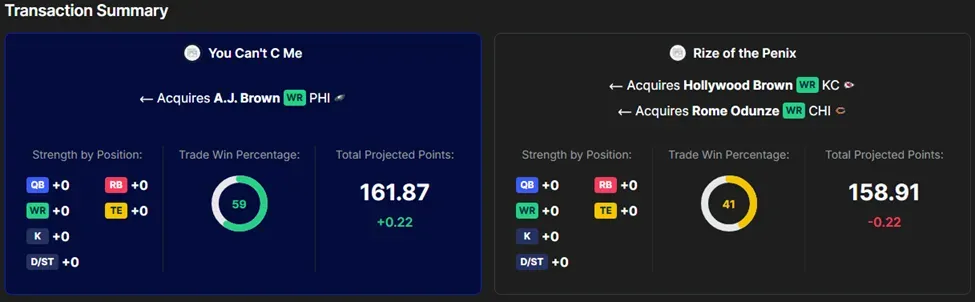
Like I said, the essence of buying low is leveraging short-term risk for long-term gain. While both Hollywood and A.J. Brown had UR Scores above 80, their roles within their offenses are fragile. A.J. Brown’s shouldn’t be. So, while I’d need to make some moves on the waiver wire to make up for the extra lost roster spot, the ceiling for my team went up.
Regardless, working with this tool to visualize potential trades is just the start. We can see what might be reasonable here. But, ultimately, pitching the deal to your leaguemate will be the critical step to changing your team for the better.