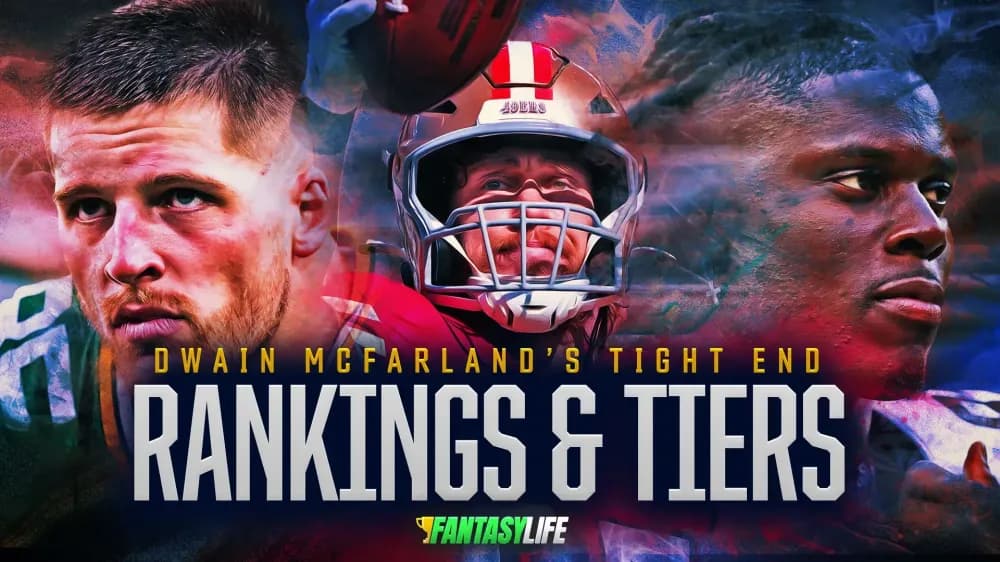
Tight End Rankings and Tiers For Fantasy Football 2025: Brock Bowers, George Kittle, and More
Dwain McFarland breaks down his TE positional rankings and tiers for the 2025 fantasy football season, who his favorite early-round TE target is, sleeper options, and more.
When I used to lead product and analytics teams, I would ask a team member pitching a new product feature or data idea, "So what, who cares?" The newbies would look at me with a puzzled look on their face (some of you might be thinking I am a real jerk right about now).
For the record, I was always nice when asking this question, but my point was a simple one. I wanted them to consider why people should care about the data or feature they wanted to add to the product roadmap. Was it rooted in good analysis, and would it help a user accomplish their goals?
If so, great, let's do it! If not, it went onto the interesting but irrelevant scrap heap. That last part might sound harsh, but the reality is that many ideas and data points are interesting but don't help us achieve our goals. That doesn't mean we can't discuss them, but they shouldn't be at the heart of our decision-making process.
In fantasy football, our goal is to win. To achieve this, we need to target the right players. To put it even more clearly, we need to target the right *types of players*. I have dedicated thousands of hours researching which data points matter for future fantasy performance.
That doesn't mean I will get everything right. There will be misses. Football is a cruel game played with an elongated sphere that can bounce in the most unpredictable ways. The critical thing to remember is that we are playing a game of probabilities.
If we can get more things right than wrong, we have a great chance of beating our opponents. The best way for me to do that is by following the data.
One final thought before we move forward: It is a great time to be a consumer of content in the fantasy football space. We have some of the brightest minds in the industry's history using a data-driven methodology to deliver league-winning insights. It's a really cool thing.
Speaking of methodology …
Tier Methodology For Tiering and Ranking Tight Ends in 2025
This article will group players into tiers based on the following data criteria.
- Fantasy points: PPR points per game
- Talent profile: Target share, yards per route run (YPRR), air yards share
- Age: Rounded up based on Week 1
- Passing offense quality: Fantasy Life projections
- Target competition: Teammate historical target shares and projections
- Player average draft position (ADP): Underdog
Fantasy points per game and talent profile
I love advanced data, but historical points per game are still the gold standard for predicting future fantasy production. However, we can gain a deeper understanding of talent by taking it one level further. The things that matter most for TEs are very similar to those for WRs.

So, what does a top-three TE look like versus a low-end TE1?

Age
As players age, the year-over-year correlation in our data decays. By comparing a TE's best three-year stretch (prime production) versus age buckets, we can see when they are at their max powers and when they decline.

Summary:
- Pre-prime: While we are seeing more rookie TE breakouts, historically, they reach 72% of their maximum production at ages 21 to 22.
- Prime: The best years for TEs are 23 to 27, but ages 28 to 29 are close.
- Post-prime: Ages 30 to 31 are similar to the pre-prime years (21 to 22).
- Decline: TEs decline more gracefully than WRs.
Another interesting tidbit I found when digging into TEs was how much target share against man coverage mattered for players age 30 or older. It slightly edged out PPR per game for the strongest correlation with next-season points, at 0.87 compared to 0.84.
Passing offense quality and target competition
The final step is to assess a player's environment. TEs who reside in high-powered passing attacks have enjoyed more success reaching the top six. However, the data is more evenly distributed for TEs seven through 12.

It is essential to emphasize that the offensive environment signal is significantly lower than statistics such as fantasy points per game and target share—even when accounting for playing time.
- Team passing yards correlation to current-season fantasy points: 0.37
- Team passing yards correlation to next-season fantasy points: 0.22
The Fantasy Life fantasy football projections are the primary source for this assessment, which, in theory, should align more closely with current-season correlation, as we account for changes within the team. It is best to use this as a tiebreaker when evaluating similar talent profiles.
From a target competition standpoint, we prefer teams with fewer mouths to feed. Having an offensive coordinator willing to push the cheat code buttons is a bonus. The advantages of motion were more robust for WRs, but play action has been a massive boost for TEs.

Player average draft position (ADP)
Never before have we had such robust market data. Thanks to the explosion of this game we love (especially best ball), thousands of real-money drafts have already taken place for the 2025 season. We must leverage consensus ADP data.
While one of the goals of the tiers is to unearth mispriced players, I want to challenge myself when takes don't align with the market (ADP). It represents something much larger and infinitely more intelligent than one person. You should be highly skeptical if you see an analyst (including me) repeatedly pounding the table for a player moving in the opposite direction of their ADP.
In "The Logic of Sports Betting," Ed Miller and Matthew Davidow had this to say:
"Market resistance is a massive red flag that you're missing something, and the best thing you can do is stop betting into the resistance and instead try to figure out what you may have gotten wrong."
Note: Consensus fantasy football ADP is an average of ESPN, Sleeper, Yahoo, RTSports, and Underdog.
Enough methodology talk. Let's talk tiers.
Tight End Tiers and Rankings For Fantasy Football 2025
In the table below, you will find my full list of TE rankings and tiers. See below the table for in-depth analysis on each of the fantasy-relevant options.
| Tier | Rank | Player | Team |
| 1 | 1 | Brock Bowers | LV |
| 1 | 2 | Trey McBride | ARI |
| 1 | 3 | George Kittle | SF |
| 2 | 4 | Sam LaPorta | DET |
| 3 | 5 | T.J. Hockenson | MIN |
| 3 | 6 | Evan Engram | DEN |
| 3 | 7 | Travis Kelce | KC |
| 3 | 8 | David Njoku | CLE |
| 4 | 9 | Tyler Warren | IND |
| 4 | 10 | Mark Andrews | BAL |
| 4 | 11 | Colston Loveland | CHI |
| 4 | 12 | Tucker Kraft | GB |
| 4 | 13 | Dalton Kincaid | BUF |
| 5 | 14 | Dallas Goedert | PHI |
| 5 | 15 | Jake Ferguson | DAL |
| 5 | 16 | Isaiah Likely | BAL |
| 5 | 17 | Kyle Pitts | ATL |
| 5 | 18 | Hunter Henry | NE |
| 5 | 19 | Brenton Strange | JAC |
| 6 | 20 | Zach Ertz | WAS |
| 6 | 21 | Cade Otton | TB |
| 6 | 22 | Chig Okonkwo | TEN |
| 6 | 23 | Mike Gesicki | CIN |
| 6 | 24 | Jonnu Smith | MIA |
| 6 | 25 | Mason Taylor | NYJ |
| 6 | 26 | Darren Waller | NYG |
| 6 | 27 | Dalton Schultz | HOU |
| 6 | 28 | Juwan Johnson | NO |
| 7 | 29 | Elijah Arroyo | SEA |
| 7 | 30 | Theo Johnson | NYG |
| 7 | 31 | Ja'Tavion Sanders | CAR |
| 7 | 32 | Pat Freiermuth | PIT |
| 7 | 33 | Terrance Ferguson | LA |
| 7 | 34 | AJ Barner | SEA |
| 7 | 35 | Oronde Gadsden | LAC |
| 7 | 36 | Tyler Conklin | LAC |
| 7 | 37 | Cole Kmet | CHI |
| 7 | 38 | Ben Sinnott | WAS |
| 7 | 39 | Harold Fannin | CLE |
Tier 1: Alpha TE1s
We have three tight ends who stand out from the pack in 2025. Each of these options offers the elite talent profile we are looking for and should operate as key cogs within their offense.

 Brock Bowers | Raiders
- Consensus ADP: 18.6 (Round 2)
Bowers collected the most fantasy points per game (15.5) for a rookie in the TruMedia database since 2000. In 14 games without Davante Adams, he averaged 16.1 points with a mouth-watering 28% target share and 25% air yards share. He excelled against man and zone:
- Vs. Man: 22% targets per route run (TPRR), 1.90 yards per route run (YPRR)
- Vs. Zone: 29% TPRR, 2.38 YPRR
The average for an NFL tight end with 250 routes in a season since 2011:
- Vs. Man: 17% TPRR, 1.23 YPRR
- Vs. Zone: 18% TPRR, 1.54 YPRR
Bowers was 61% better than the NFL average in zone TPRR and 55% better in YPRR. In a league that runs zone ~70% of plays, that's good stuff, y'all.
The only nitpick on Bowers is his 6.6-yard average depth of target (aDOT), which could hinder TD upside. Since 2011, high-end target earners at TE with an aDOT below 7.5 averaged 5.2 TDs. Bowers had five last year.
The nine-plus aDOT cohort averaged eight scores. The TEs who broke fantasy leagues not only earned targets, but they did it downfield and scored TDs. There have been seven 18-plus PPG campaigns from TEs since 2011:
- Jimmy Graham (2X): 10.5 aDOT with 16 TDs; 10.1 aDOT with 11 TDs
- Rob Gronkowski (2X): 10.6 aDOT with 11 TDs, 9.6 aDOT with 17 TDs
- Travis Kelce (3X): 7.6 aDOT with 12 TDs, 9.4 aDOT with 11 TDs, 9.4 aDOT with 10 TDs
This passing attack will center around Bowers and Jakobi Meyers. The Raiders struggled with lackluster QB play last year and still managed 225 yards per game. With Geno Smith at the controls, we could see an improvement. Smith averaged 254, 242, and 254 over the last three years.
Pete Carroll and Chip Kelly will look to create balance and keep defenses on their heels with first-round pick Ashton Jeanty pounding the rock—the Raiders are a sneaky candidate to make a significant jump as an offense in 2025.
Bowers is worthy of a mid-round two selection in drafts after the top WRs and RBs are off the board.
 Trey McBride | Cardinals
- Consensus ADP: 26.5 (Round 3)
McBride erupted for 15 PPG in 2023 after taking over the starting role for the final 10 games of the season. He followed that up in Year 3 with 15.6 PPG and secured the No. 1 Utilization Score (94) at the position.

McBride profiles almost identically to Bowers. He is a target hog who can beat man (24% TPRR) and zone (24% TPRR), but most of his work comes underneath with a 6.5 aDOT. That is a factor when it comes to scoring TDs, which McBride has only six of on 221 receptions in his three-year career.
While his skill set and role may limit his TD upside, he is in a position to experience positive regression. His closest comparisons using target share and aDOT averaged 5.2 per season since 2011.
Kyler Murray and Drew Petzing haven't joined forces to ignite this passing game yet (226 per game). But this should remain a highly concentrated offense. The Cardinals rank seventh in play-action rate (27%) with Petzing. Of TEs with 350+ routes, McBride ranked seventh in percentage of targets off play action at 32%.
Even if Marvin Harrison Jr. takes a big leap forward, the Cardinals don't have a third option strong enough to challenge McBride in a meaningful way.
McBride is an excellent target in Round 3 of drafts—he goes at pick 28 on ESPN and Yahoo.
 George Kittle | 49ers
- Consensus ADP: 39 (Round 4)
With the 49ers dealing with injuries to Brandon Aiyuk and Christian McCaffrey, fantasy managers were reminded how good this man is at football. Kittle led all TEs with 15.8 PPG and averaged 16.6 with a 22% target share if you exclude Week 18, when he only played 30% of snaps.
With Aiyuk recovering from a mid-season ACL injury, Deebo Samuel gone, and Ricky Pearsall as an unproven No. 2 WR behind Jauan Jennings, we should see another strong target share season for Kittle.
Kittle's age pushes him below Bowers and McBride in the tier, but he offers the most play-making upside in the group. With less target competition, he rebounded with a massive 2.62 YPRR, looking more like the old Kittle:
- 2018: 2.82 YPRR
- 2019: 3.12 YPRR
- 2020: 2.84 YPRR
Over the last two seasons, he posted aDOTs of 9.9 and 8.9. Kittle has the skills to earn targets and get downfield, unlocking serious TD upside.
Brock Purdy averaged 268 and 258 yards in 2023 and 2024. Over the last three years, Kyle Shanahan ranks second in motion (64%) and two-WR sets (39%). Kittle saw 32% of his targets (eighth) off play action in 2024.
Kittle is my favorite early-round TE target in 2025, thanks to his Round 4 price tag and massive upside.
Tier 2: The Sam LaPorta Tier

 Sam LaPorta | Lions
- Consensus ADP: 59 (Round 5)
LaPorta was the No. 1 tight end selected in 2024 fantasy drafts thanks to his 13.8 PPG rookie season. Unfortunately, LaPorta averaged only 11.3 PPG, leaving drafters frustrated. Here's the good news: he was playing hurt over the first half of the year.
The second-year TE missed time in training camp with a hamstring and then suffered an ankle injury in Week 3. Starting in Week 12, he regained a full-time role, posting a healthy 87% route participation over the final eight games, including the playoffs. Over that span, he upped his Utilization Score to 86 with 14 fantasy points per game.

It is a crowded attack in Detroit, Ben Johnson is gone, and Jared Goff is due for negative regression. Still, lean toward the team still being one of the best offenses in the league, and LaPorta will battle Jameson Williams for the No. 2 spot in the pass-game pecking order.
Admittedly, I haven't gone out of my way for LaPorta in drafts, but TE4 feels right for a proven young TE on a quality offense.
Tier 3: Veteran Mid-Range TE1s

 T.J. Hockenson | Vikings
- Consensus ADP: 71 (Round 6)
Recovering from a late-2023 torn ACL and MCL, Hockenson didn't find his way into a full-time role until Week 12. He averaged 10 points per game with an 18% target from Week 12 through the playoffs.
For most of his career, Hockenson has been a mid-range to low-end TE1.
- 2020: 11.0 PPG (Lions)
- 2021: 11.9 PPG (Lions)
- 2022: 12.6 PPG (Lions/Vikings)
- 2023: 14.7 (Vikings)
- 2024: 9.4 (Vikings)
2023 was by far his best campaign, but it comes with a caveat—Justin Jefferson missed seven complete games and much of two others.
- Games with Jefferson injured: 15.7 PPG
- Games with Jefferson healthy: 12.9 PPG
We trust Keven O'Connell to keep this offense rolling regardless of the QB, but there is at least some risk with unproven J.J. McCarthy taking over for Sam Darnold. The Vikings rank third in play-action rate under O'Connell (30%). Jordan Addison is likely to miss time due to a suspension early in the year, which could help Hockenson get off to a hot start.
Hockenson is another player I haven't gone out of my way to draft, but he offers a solid floor as a key cog in a Kevin O'Connell offense. The challenge: he is priced multiple rounds ahead of some tier mates.
 Evan Engram | Broncos
- Consensus ADP: 96 (Round 8)
Engram rejuvenated his career in Jacksonville, averaging 10.8, 13.7, and 9.9 PPG. While injuries hampered last year's production, Engram still managed a 25% target share after notching a 24% share in 2023.
He has fared equally well versus man and zone over the last two years.
- Vs. man coverage: 25%, 23% TPRR
- Vs. zone coverage: 24%, 28% TPRR
He is primarily an underneath option (5.8) aDOT, which limits his TD upside, but Engram offers considerable reception potential. The veteran collected 114 grabs in 2023 and was on pace for 89 in 2024. He fits well with Sean Payton's scheme, and the target competition is thin.
Courtland Sutton collected a career-high 26% share last season, and the backs will get targets. Still, that leaves room for Engram to continue operating in that 22-24% range. I have Engram projected for 104 targets and 79 receptions.
Engram should be one of the top two passing options in a Broncos offense that could take a step forward in Year 2 with Bo Nix at the helm.
 Travis Kelce | Chiefs
- Consensus ADP: 76 (Round 7)
Kelce's production took a significant hit in 2024, dropping from 16.2 PPG to 12.3. While his target share (25%) remained strong, he experienced a substantial downturn in multiple key data points, part of a three-year trend.
- YPRR: 2.23 → 1.92 → 1.43
- Average yards after catch: 6.0 → 5.0 → 3.5
- ESPN Open Score: 78 → 72 → 59
While my expectation for the Chiefs' passing attack is a considerable rebound, much of it centers around the other weapons. Kelce could keep his target share going while Rashee Rice is out. However, there is a significant risk once Rice returns, especially if Xavier Worthy also plays well. Worthy took over a full-time role in Week 14 last year, and Kelce's targets fell to 22%.
Kelce belongs in this tier thanks to a decent target projection (107) in an offense that could bounce back. Still, he is a tough click in Round 7, due to less expensive options.
 David Njoku | Browns
- Consensus ADP: 100 (Round 9)
Njoku profiles similarly to Engram but in an offense with much bigger questions at QB. The upshot is that Njoku has overcome that obstacle over the last two years with 13.1 and 12.8 PPG campaigns.
Joe Flacco, Kenny Pickett, Dillon Gabriel, and Shedeur Sanders will battle for the starting QB role. In 2023, with Flacco under center for six games, Njoku averaged 16.2 points per game with a 28% target share and 2.02 YPRR.
He is another low-aDOT option who doesn't offer significant TD upside, but could gobble up targets underneath the defense. That makes him more valuable in PPR formats.
Jerry Jeudy has not proven to be a consistent target earner but flashed to finish last season, as did Cedric Tillman over a four-game stretch. If Diontae Johnson maintains his composure, he will pose a significant threat to Njoku's targets from the slot. Currently, I have Njoku's target competition graded as low because I don't think any of his teammates are strong bets to explode. Still, if two of them are solid, it will change the dynamics.
Njoku projects for 100+ targets in a lackluster offense. He is a volume play in PPR leagues.
Tier 4: Upside Borderline TE1s
When I don't get one of the big three tight ends, the players in this tier become my primary targets. They all have question marks, but also offer underlying traits we can get excited about.

 Tyler Warren | Colts
- Consensus ADP: 120 (Round 10)
Some of you are looking at the low team passing projection and the high target competition and wondering if I have lost my mind. How did you feel about Brock Bowers' situation heading into 2024, given the presence of bad quarterbacks and Davante Adams?
My point isn't to say that Warren will be Bowers, but talent is the trump card. A lot can change in a hurry in the NFL, and we want players with underlying upside to emerge when their chance comes.
Yes, the Colts have rotated their TEs often over the years, but they have been a mixture of blockers and receivers. And none of them were the No. 14 pick in the NFL Draft. I expect Warren to assume a full-time role quickly.
Warren is a yards-after-catch monster, and pairs perfectly with Shane Steichen's RPO-heavy scheme. The Colts rank first in RPO rate (22%) and fourth in play action (28%) in two years under Steichen. Look for Indianapolis to scheme up a lot of easy looks with space to run for their newest toy.
Warren is my most drafted TE through 65 drafts (21.5%), as you can see in our Best Ball Player Exposure tool.

Tyler Waren is my No. 9 TE. He is the type of player I am willing to be wrong on. First, he isn't that expensive. Second, he offers the kind of upside that can help us offset the early TE drafters. That is not an easy combination to find!
 Mark Andrews | Ravens
- Consensus ADP: 88 (Round 8)
Andrews' name sticks out on this list because he is the oldest player. Yet, that doesn't change why he is in the tier: Upside.
While his PPG fell from 12.5 in 2023 to 10.8 in 2024, he was coming off a cracked fibula and ligament injury from the previous November. Then he was in a car accident in August. Those events may have contributed to his slow start. Andrews picked things up starting in Week 6 and averaged 13.1 points over the next 14 games.

Andrews pairs his target earning ability (22% TPRR) with a deeper aDOT (10.8), which, historically, has been part of the recipe for massive tight end seasons, like the 17.5 PPG he provided in 2021. Without Isaiah Likely in the picture, Andrews would be in Tier 2 with LaPorta.
Todd Monken knows how to scheme up those deep looks for his big TE. The Ravens rank fifth in play-action pass rate (28%) and third in two-WR sets (38%).
The bottom line is that Andrews is a top two or three passing-game option in an offense that should score a ton of points. He is a low-end TE1 with contingent high-end TE1 upside.
 Colston Loveland | Bears
- Consensus ADP: 124 (Round 10)
Loveland is the fifth-highest rated TE in the history of the Rookie Super Model.

His comparisons notched a top-12 TE finish 100% of the time by Year 3, and 33% made it to top-three status. This is an excellent prospect that can attack all layers of the field and create mismatches versus linebackers and safeties.
He is working through a pre-draft shoulder injury but should be nearing full strength by Week 1. Due to this and the presence of a solid veteran in Cole Kmet, we could see a slower start for Loveland than Warren. However, if Loveland displaces Kmet, his ceiling scenario is higher.
The Bears' offense was a complete disaster last season, but Ben Johnson takes over as playcaller, and the offensive line now ranks as one of the better units for PFF and Brandon Thorn.
Loveland might be tough to start early in the season. But he offers upside you won't find later in the draft. If he takes over quickly, we could see a top-six finish as a rookie. He is my fourth-most drafted TE at 14%.
 Tucker Kraft | Packers
- Consensus ADP: 120 (Round 10)
Kraft was not a high-end target earner last year (15%), but he was a terrific after-the-catch performer with a 9.3-yard average. While many of his big plays came in long-down-and-distance situations where the defense was covering downfield receivers, Kraft offers an intriguing upside that the Packers could decide to tap further into in 2025.
After Luke Musgrave went down in Week 4, Kraft averaged 10.7 points.
The Packers selected WR Matthew Golden in Round 1 of the NFL Draft, and Jayyden Reed offers Year 3 breakout potential. However, Kraft is also in the mix for a larger workload and could surprise as the top option in Green Bay's attack.
Matt LaFleur's attack ranks sixth in motion rate (54%) and 10th in play action (26%) over the last three seasons. He is a playcaller with the skillset to design more favorable looks in space for Kraft underneath the defensive coverage.
Kraft is a borderline TE1 with mid-range TE1 upside.
 Dalton Kincaid | Bills
- Consensus ADP: 128 (Round 11)
I can hear the sighs. I get it. Kincaid has been a bust so far. His production actually got worse, falling from 9.8 PPG to 7.1 in Year 2.
Still, Kincaid has a few things working in his favor.
- He has battled knee, shoulder, and concussion injuries. We may not have seen the real Dalton Kincaid yet.
- His 26% TPRR last year was TE1-worthy. Playing time was a challenge, but he earned targets when on the field.
- Year 3 is a decent year for TE breakouts who were taken in the first two rounds. The first-time TE1 hit rates are 38% in Year 3, compared to 11% in Year 1 and 17% in Year 2. Despite early breakouts from Bowers and LaPorta, this position has historically taken longer. He is on a similar trajectory to Dallas Goedert.
Finally, the Bills' target pecking order is wide open. Khalil Shakir is their best player, and no one behind him has shown significant target-earning aptitude to this point. The Bills have morphed into a run-balanced unit under Joe Brady (-1.8% dropback rate over expectation), but the guy under center is still named Josh Allen.
It won't be fun considering Kincaid as your Week 1 starter, but he offers breakout potential. We can cut him if he doesn't play well quickly.
Tier 5: TE2s
- Dallas Goedert | Eagles: Goedert offers contingent upside should A.J. Brown or DeVonta Smith miss time. He delivered a substantial 21% target share and his second-best YPRR (2.20). Goedert is a high-end TE2.
- Jake Ferguson | Cowboys: Ferguson loses some of his appeal with the arrival of George Pickens, but still figures to be the No. 3 option for the Dallas passing attack. Ferguson is a mid-range TE2.
- Isaiah Likely | Ravens: Likely will share time with Mark Andrews. His 14% target share last season wasn't good, but his underlying 18% TPRR was decent. Likely is a mid-range TE2 with mid-range TE1 upside should he overtake Andrews.
- Kyle Pitts | Falcons: Pitts hasn't been the same since his knee injury in 2023. Last season, he averaged 7.7 PPG and hit career lows in TPRR (14%) and YPRR (1.33). His ESPN Open Score was a dreadful 33. Still, he will only be 25, and we have seen TEs like David Njoku break out later in their careers. Pitts is a mid-range TE2 with a prayer for upside.
- Hunter Henry | Patriots: Henry could be the No. 2 option in the Patriots' passing attack behind Stefon Diggs, depending on how rookie Kyle Williams performs. Henry will likely never be a target hog, but he was Maye's safety blanket versus man coverage last season and could lead the team in receiving TDs. Henry is a mid-range TE2 with low-end TE1 upside.
- Brenton Strange | Jaguars: The third-year Round 2 draft pick took on a larger role to finish out the 2024 season after Engram went down. He posted a 17% target share with 10 PPG in five contests with a 70%+ route participation rate. Strange is a mid-range TE2 with low-end TE1 upside.
- Cade Otton | Buccaneers: Otton averaged 16.1 PPG with a 23% target share over a five-game stretch where the Bucs dealt with injuries to Chris Godwin and Mike Evans. However, his targets evaporated after Evans returned. It likely takes a similar situation for Otton to get going in 2025, but now Round 1 WR Emeka Egbuka is the favorite to soak up targets underneath. Otton is a low-end TE2.
Tier 6: Part-Timers Who Might Be Great in Full-Time Roles
- Chig Okonkwo | Titans: Okonkwo flashed as a playmaker early in his career, but the Titans have always limited his reps. However, to finish out the 2024 campaign, they gave him a full-time role for two games. With an 85% route participation, he posted 14 PPG with a 27% target share. It's a small sample, but Okonkwo might have the talent to be the No. 2 option in Tennessee. Okonkwo is a sleeper TE2.
- Mike Gesicki | Bengals: Gesicki saw a 60% route participation or higher in six games (mainly with Tee Higgins injured). He averaged 13.6 PPG over that stretch. The Bengals signed Gesicki to a three-year $25M contract this offseason. If he can wrestle away more routes, he will quickly climb the TE ranks in the Bengals' high-flying attack. Gesicki is a boom-bust TE2 with TE1 upside if his playing time improves.
- Jonnu Smith | Steelers: Arthur Smith didn't give Smith a full-time role in Atlanta, and the Steelers also have Pat Freiermuth on the team. The veteran TE took over a full-time role starting in Week 7 for Miami last year. He proceeded to explode for 16.4 PPG. Smith is a low-end TE2 with TE1 upside in a full-time role.
- Mason Taylor | Jets: This tier title might not be the best fit for Taylor, he could take over the starting role for the Jets immediately. Taylor is a
- Darren Waller | Dolphins: The Dolphins traded for Waller after moving on from Smith. Waller is unlikely to take on a full-time role. However, if the passing offense struggles again and needs more quick hitters underneath, Waller could see more work like Smith did. Waller is a low-end TE2.
- Juwan Johnson | Saints: Johnson has never played a full-time role, but Taysom Hill won't play this year, which could open up a few more routes. Johnson is a low-end TE2.
- Elijah Arroyo | Seahawks: Arroyo will probably split time with AJ Barner, but he offers the size-speed combo that would best complaint Jaxon Smith-Njigba and Cooper Kupp. Arroyo is a sleeper TE2.

Join Our Newsletter
Trusted by 400,000+ fantasy football players. Get access to Fantasy Life's free award winning newsletter and tools, all in one step.
By registering or logging in, you agree to our Terms of Use and Privacy Policy.