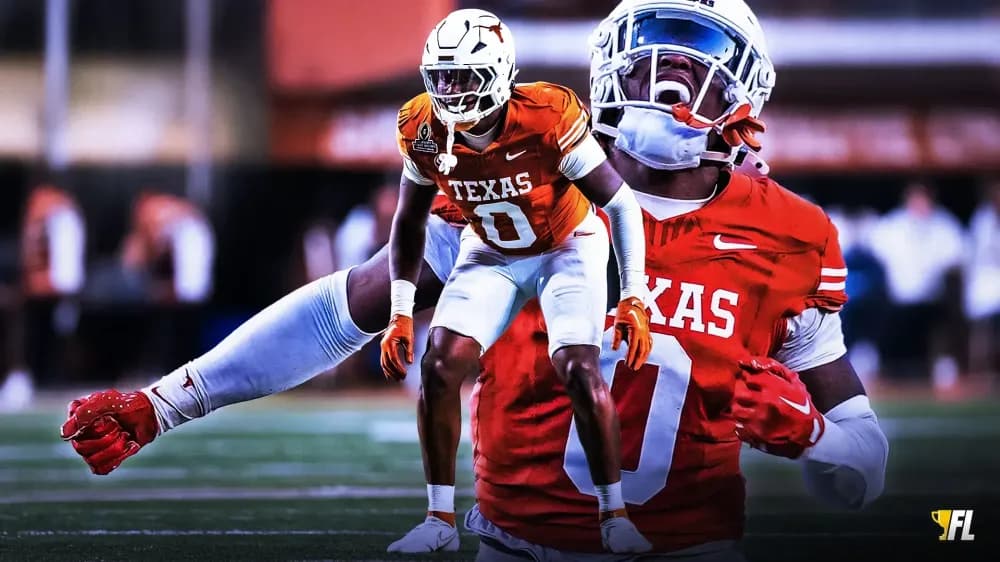
2026 NFL Draft Defensive Line Rankings: Peter Woods, T.J. Parker, and More
Thor Nystrom breaks down his defensive line rankings for the 2026 NFL Draft, including EDGE rushers, linebacks, defensive tackles, and more.
My positional previews of the 2026 NFL Draft class continue as today we will focus on the front seven—my defensive line rankings for the 2026 NFL Draft.
To view the rest of my positional previews, visit my author page. You can also get 20% off your FantasyLife+ subscriptions ahead of your drafts with code: THOR.
Defensive Line Rankings For The 2026 NFL Draft
Defensive Tackle
1. Peter Woods | Clemson | 6020/315 | JR
A top-five overall recruit in 2023, Woods chose Clemson, which has sent a procession of DTs to the NFL during the Dabo Swinney era, including Dexter Lawrence, Grady Jarrett, and Christian Wilkins.
Woods was a factor from Day 1, posting an 87.6 PFF grade as a true freshman. In 2024, as a true sophomore, Woods remained disruptive despite playing through a leg injury suffered on a chop-block in September against Appy State. That injury ultimately held Woods to three sacks and nine TFL over 395 snaps.
Clemson used Woods in a wild way last fall. Through Week 10, he was predominantly an EDGE rusher … lined up as a 4-3 defensive end. Not only that, Woods took a decent chunk of his pass-rushing snaps standing up.
It was an incredible sight to see a 315-pounder beating future NFL offensive tackles to get hands on the quarterback against Georgia and Florida State. Springy, powerful, and replete with a deep bag of pass-rushing moves, Woods was a handful on the boundary.
In Week 12 against Pittsburgh, Woods shifted back to a traditional B-gap DT role, and that’s mostly where he stayed down the stretch, also moonlighting with some nose tackle snaps. In 2024, Woods ended with 171 snaps at DE and 224 at DT.
Woods lacks ideal arm length. His dominance—and the way he dominated—across a statistically notable sample at every defensive line position his first two years on campus assuages those concerns.
Woods’ propulsion off the snap at his size tends to erase his length disadvantage, and his hand usage tends to win him the headstart in the rep from there.
For a big boy, Woods’ movements are very sudden—he’s jerky and violent in tight quarters, forcing offensive linemen to deal with a combination of power and quickness that can have a discombobulating effect.
He’s a legitimate weapon against the run because of how quickly he frees himself into the backfield, and how quickly he sprang from Point A to Point B at his size. When he’s free to hunt, Woods either bags his prey quickly or he inverts the play concept dramatically, forcing a running back to audible against the grain, or forcing the quarterback into a scramble drill.
Woods doesn’t always have to show his pass-rushing arsenal because of how naturally disruptive he is through physical gifts and instincts. But we’ve seen ludicrously impressive flashes. There are reps where Woods throws three clean moves at an offensive tackle and turns into David Blaine disappearing into a plume of smoke.
In the NFL, where margins thin, he’s going to have to tap into this aspect of his game far more. But the fact that Woods posted a 92nd-percentile pass-rush win percentage last year while not playing at his ideal position half the season and not being 100% healthy once he was should tell you how disruptive he is.
Woods, who will not turn 21 until the month before the 2026 NFL Draft, is back to full health. And after Clemson signed DE Will Heldt in the portal, Woods was shifted back to his natural DT position for the 2025 season. Expect Woods to have a monstrous final year on campus before declaring early for the NFL Draft, where he won’t have to wait long to hear his name called.
2. Caleb Banks | Florida | 6061/334 | rSR
Banks spent two uneventful years at Louisville before transferring to Florida ahead of the 2023 season. He broke out last fall while playing a career-high 421 snaps (up 59 from the year before).
This year, we’d expect Banks to play even more snaps, and we’re anticipating another jump in his game. Banks is an absolute unit—a wide-bodied 6-foot-6 with Stretch Armstrong arm length (85 ⅛ wingspan) and huge meat cleaver hands.
Banks, a high school basketball standout, is more nimble and quick than he has any business being at his 330-plus pounds. He’s well-proportioned and doesn’t carry a ton of bad weight. Banks’ estimated 5.15 forty is decent for his size but nothing special. But Banks is very quick in short areas.
What makes Banks so intriguing is that he’s a plus interior pass-rusher at his enormous dimensions. Last year, he had seven more hurries and eight more pressures than Peter Woods while playing only 26 more snaps.
Like Kenneth Grant from the last class, Banks’ play style belies his frame. Instead of parking and occupying, Banks is a chaotic hunter, looking to crash the gates and make plays in the backfield.
Because of that, he likely is a better fit as a 4-3 nose tackle than over-center in a 3-4. Banks could stand to work on his run defense in general, finding a better marriage between his gate-crashing prerogative and his defense’s need for him on certain concepts to keep gap-integrity.
Last year, Banks ended up with seven fewer run stops, per PFF, than Woods. A part of that merely comes down to gap discipline and playing more team-run defense. Another aspect is buttoning up his tackling—Banks’ chaotic game can sometimes get him on the doorstep very quickly, only to barge into the side of the house as opposed to kicking down the door. He missed six tackles last year for a problematic 26.1% missed tackle rate. That was more than double the year before, so we’d expect a big improvement in 2025.
3. Domonique Orange | Iowa State | 6016/328 | SR
Orange was a three-star recruit from Kansas City who the Cyclones have polished into a star. He’s an intriguing physical specimen at 6’2/328 pounds with above-average length (33’ ¾ arms, 81' wingspan).
“Big Citrus” and the Iowa State Cyclones kicked off the 2025 college football season in Dublin on Saturday against Kansas State. In a driving rainstorm, we got a vintage Orange performance, mucking things up on the inside.
In the second quarter, with the Wildcats facing a 4th & 1 in the red zone, Orange took on a triple-team to free a second-level defender to come down clean and stuff the runner behind the line, resulting in a turnover on downs. This play encapsulated Orange’s game as good as any.
Orange’s game is built on power. He’s a high-end run defender who maintains gap integrity. As Kansas State found, it is next to impossible to move him backwards, even if you devote multiple offensive linemen to doing so. ESPN reported during Saturday’s telecast that Orange has a 34-inch vertical and benches 450, squats 650, and cleans 365.
Before last year, Orange was mostly just a run-stuffing nose tackle. But in 2024, Orange started to show some pass-rushing utility. Orange has a quick first step, and he’s got heavy hands. Those hands are active, and his pass-rushing moves are led by them and his overall wrecking-ball power.
Orange is never going to post a big sack number, but it looks like he could develop into a bull-rushing pocket-pusher at the next level.
Orange is a player who NFL defensive coaching staffs are going to be pounding the table despite relatively modest collegiate statistical production. Orange’s ability to drive single-man blocks backwards and eat double-teams without moving an inch will be an accelerating force to the run defense of whatever NFL team selects him.
4. Darrell Jackson Jr. | Florida State | 6052/341 | rSR
A hulking nose tackle, Jackson boasts the length of an octopus—7-foot-2 wingspan—and nuclear-reactor power. At present, he’s a flash player with explosive reps who disappears for stretches. He needs to improve his pad level, and improving his conditioning would likely help with that. He’s in play for Round 1 in April if he shows that this fall.
Best of the rest …
- Tim Keenan III | Alabama | 6023/313 | rSR
- Christen Miller | Georgia | 6040/305 | rJR
- Dontay Corleone | Cincinnati | 6000/331 | rSR
- David Oke | Arkansas | 6016/312 | SR
- Rayshaun Benny | Michigan | 6030/300 | rSR
- Zxavian Harris | Ole Miss | 6071/330 | SR
- Zane Durant | Penn State | 6010/290 | SR
- Albert Regis | Texas A&M | 6011/310 | rSR

EDGE Rusher
1. T.J. Parker | Clemson | 6030/265 | JR
A top-100 recruit out of high school, Parker burst onto the scene in 2023 with 12.5 TFL and Freshman All-American honors. Over 1,085 career snaps across two seasons, Parker has posted 32 TFL, 16.5 sacks, and six forced fumbles.
Parker is an explosive outside rusher in a big package. He runs an estimated mid-4.5s forty at 260-plus pounds. Parker effectively converts speed-to-power off the snap—his bull rush is above the pay grade of most collegiate tackles he has faced.
I’d like to see more pass-rushing moves out of Parker this fall. I appreciate Parker’s no-nonsense, no-frills approach, and I appreciate the argument that guys like Myles Garrett have made that most NFL sacks come directly from speed-to-power explosion. Still, Parker’s initial plan is going to be stymied more in the NFL than the ACC, and having additional tools to deal with that will prove helpful.
What I like about Parker’s current pass-rushing plan is his hand usage and the way he weaponizes his length. When Parker stabs an offensive lineman’s chest with a long arm, he tends to render them feeble like a fish on a spear, unable to grapple back to neutral. They’re along for the ride until he discards.
Parker is a high-motor, high-activity presence. He takes the shortest path to the target and closes the gap very quickly. Parker has an angular style, and he’s got a little hip stiffness. He’s a very good athlete, but not a freakish one. Still, he’s been highly productive, with 11 sacks and 51 pressures last season.
Parker has been an upper-echelon collegiate run defender the past couple of years. He’s extremely disruptive because of his push-the-envelope play style and rabid backside pursuit, swerving through traffic at high speeds to get home.
On concepts to his side, Parker shows quick play recognition, and he’s shown the ability to set the edge and funnel. This area is inconsistent, however. Parker is more comfortable flying downhill and creating chaos. He is not as comfortable when the offensive lineman is coming forward—he’s got the length and strength to hold his ground, but needs to work on refining his technique.
2. Keldric Faulk | Auburn | 6060/270 | JR
Faulk is a bully-ball defensive end with a physical game. A former consensus top-100 overall recruit, Faulk flipped from Florida State to Auburn before Signing Day. He is likely to become Auburn’s first defensive lineman to go in the first round since Derrick Brown in 2020.
You can’t teach Faulk’s combination of size, length, and athleticism. Those traits, in conjunction with his physical bent, make Faulk an elite run defender. Faulk has electric hands that set the tone in reps.
He straightens out offensive tackles and stalls their forward momentum with a punch to the chest, and I appreciate how quickly he deciphers the concept of knowing whether it’s time to hold his ground and wait for support or whether it’s time to shed and hunt.
In large part because Faulk so reliably stakes himself to leads early in reps, he consistently is able to shed. When Faulk gets home, he’s making the play—he’s a reliable tackler who wraps while driving through the target.
Faulk is one of two returning EDGE defenders who had 32-or-more-run stops in 2024 (33) while missing four tackles or fewer. Faulk improved as a pass-rusher last year while displaying more down-to-down consistency. He finished with nine sacks and 42 pressures.
At present, Faulk wins most of his pass-pro reps with his combination of explosion, length, and strength, converting speed to power. The next step in his evolution will be adding more nuance to his approach and more pass-rushing moves to his repertoire.
3. Rueben Bain Jr. | Miami (FL) | 6030/275 | JR
Bain is a sawed-off edge defender with a game like a shotgun blast, chaotic and powerful. He’s turned his frame into an advantage by firing out of the blocks low and consistently winning the leverage battle.
Bain was a revelation in 2023 as a true freshman, posting 13 TFL and 7.5 sacks. There was an expectation last summer that he would be one of college football’s most destructive defensive forces in 2024.
Instead, a soft-tissue calf injury suffered on the very first drive of the 2024 opener against Florida on Aug. 31 wreaked havoc on Bain’s season—he took only three snaps in that game, and we didn’t see him again until Oct. 5 against Cal.
The first few games back, with Bain not appearing to be quite 100%, Miami didn’t play him for all of its defensive snaps. On tape, Bain’s explosiveness looked to be the area most hindered.
Bain was limited to nine games in 2024. Really, that was more like eight games. He took 205 fewer snaps than the year before, and his sack total plummeted to 3.5. His shoot-em-up brand of run defense remained intact, however, and Bain finished the campaign with an elite 82.7 PFF run defense grade.
When Bain is right, he’s a movable piece for Miami’s defensive staff. Bain has enough athleticism and length for the EDGE position. But his compact build and violent style also play at three-technique in obvious passing situations. The Hurricanes have given him 187 snaps at three-technique over the past two seasons. With even 10 more pounds of muscle, a similar usage pattern would be possible in the NFL.
Bain is now fully healthy, and he’s improved his body composition through diet with the ultimate goal of swapping body fat for lean muscle. He’s got a big opportunity in front of him to fully regain any lost momentum from last year’s injury-mired campaign.
Miami has several high-profile games on the schedule this fall—including Notre Dame, Florida, FSU, Louisville, and SMU. If Bain remains healthy and the pass-rushing chops we saw in 2023 return, he will have a chance to declare early for the NFL Draft and hear his name called in Round 1.
4. Matayo Uiagalelei | Oregon | 6040/270 | JR
The younger brother of former Florida State QB DJ Uiagalelei, Matayo is a former top-50 recruit. He broke out in 2024 with 10.5 sacks for a top-10 national defense.
The next step of Uiagalelei's evolution will be diversifying his pass-rushing arsenal while becoming more down-to-down consistent against the run. As a pass-rusher, Uiagalelei's combination of first-step quickness, speed, length, and play-to-the-whistle hustle tends to stake him to lead early in reps and allow him to run into big plays later in them.
But he isn’t yet quickly countering when his first plan is shut down, and he doesn’t yet have a full arsenal of counters. NFL offensive tackles will be sitting back on their heels waiting to shut down the speed until Uiaglelei proves he can throw more at them.
And while Uiagalelei has shown flashes in run defense, wracking up solid solo tackle numbers by taking matters into his own hands, he could stand to play more assignment-minded football in this phase. Failing to keep gap integrity has gotten his side of the line of scrimmage gashed for unnecessary yardage at times.
Best of the rest …
- Zion Young | Missouri | 6051/255 | SR
- David Bailey | Texas Tech | 6030/247 | SR
- Cashius Howell | Texas A&M | 6021/249 | rSR
- LT Overton | Alabama | 6023/274 | SR
- Dani Dennis-Sutton | Penn State | 6055/265 | SR
- Anthony Smith | Minnesota | 6060/285 | rSR
- R Mason Thomas | Oklahoma | 6015/249 | SR
- Trey Moore | Texas | 6014/246 | rSR
Linebacker
1. Anthony Hill Jr. | Texas | 6030/235 | JR
Hill Jr. played heavy rotational snaps as a true freshman in 2023 after signing with Texas as a five-star recruit. Last season, as a true sophomore, Hill had his national coming-out party, finishing with 113 tackles, 17 TFL, eight sacks, four forced fumbles, and a fumble recovery.
The bad news is that he was a bit flattered by the counting numbers. The good news is that he has a huge ceiling.
Hill is a tremendous athlete in a big package. A high school track star, Hill is a flashy mover who is going to blow the roof off the NFL Combine this spring. He reportedly runs a low-4.4s forty.
Fluid and springy, Hill consistently makes plays outside the tackles. He moves laterally as well as he does north to south. Between the tackles, Hill is slippery and moves with conviction. He could do a better job disengaging from blocks. Hill has a tendency to use himself as a battering-ram projectile into contact, which slows the blocker, but which doesn’t always give Hill the best chance to use his hands and arms to free himself during the post-collision aftershock.
Hill is a terror on the blitz (23 pressures) who must always be accounted for. Hill is crafty on the prowl—he does a good job disguising his intentions pre-snap, and he has a feel for timing his trigger to the opening, which can free him to sprint unimpeded.
Hill’s game has two issues, at present: Diagnosing plays and coverage in general.
Hill is at his best when he is freed to fly downhill without having to read the play. Play designs with misdirection or other forms of subterfuge can get his cleats stuck in the mud for an extra beat or two, or coax him into a couple of false steps that can ultimately remove him from a play. The hope is that his anticipation skills will continue improving through experience.
In coverage, Hill’s natural athleticism plays down. At present, you’re only going to trust him in zone. And to Hill’s credit, he looked more natural and fluid dropping last season, and he seemed to be a bit more comfortable with what he was seeing in front of him.
There’s still too much thinking going on out there, however. Last year, Hill Jr. was nicked for 52 receptions and 478 yards, coughing up a 108.9 QB rating against. He had a couple of nice moments disrupting passing windows, and he had an interception and two passes defensed.
Hill’s combination of length and athleticism makes him a problem at the catch point when he can get there. But until he starts deciphering route concepts quicker, he’s going to remain a reactive pass defender who can be paper-cut.
Lastly, while Hill is admirably always around the ball, he needs to clean up his tackling. He’s missed 26 tackle attempts over two seasons for an elevated 13.7% missed tackle rate. We want to see that number slashed to under 10% as a true junior.
Hill has all the physical ability in the world. If he improves on his diagnostics and coverage in 2025, he’ll be a top-10 overall possibility this spring. If those don’t come around before his declaration for the NFL Draft, it’s also possible that he could slip into Round 2.
2. C.J. Allen | Georgia | 6010/235 | JR
C.J. Allen is not as physically gifted as Anthony Hill. He has a compact build, and he’s a good athlete, but not an elite one. But Allen is, bar none, the best run-defense linebacker in this class.
Allen is stout, violent, and blessed with mid-4.5s wheels at a shade under 240 pounds. He reads and triggers very, very quickly—and tends to push the envelope, breaching gaps and detonating plays early because of it. The speed with which Allen reads the play concept tends to play up his athleticism.
Allen is a powerful force coming downhill. He is willing to take on blockers, and he knows how to free himself from them. I also like the snap-bang calculations he makes of whether to sacrifice himself to play team run defense and when to take matters into his own hands.
Either way, you don’t often see him cheating the team by running around a block, nor do you see him freelancing – he can be trusted to do his job within the concept, and to do it well. He’s both a physical hitter and a reliable wrap-up tackler. Allen was No. 2 on the Bulldogs last year in tackles while posting an elite 6.0% missed tackle rate.
The reason I can’t rank Allen higher than this is that he is not currently a big value-add on passing downs. Georgia doesn’t blitz their linebackers a ton, so Allen has only 122 pass-rushing reps over two seasons. He only has one career sack.
It’s possible this area of his game will play up a bit in another system—I just don’t ever see him becoming elite. My bigger concern is in coverage. In zone, Allen gets to his spot and squats. He doesn’t have the best feel yet for the circumstances that should spur him to action outside of his area.
I noticed a few occurrences of the opponent sending receivers down the field, and leaking a running back into a vacated flat where Allen did not decipher until the ball left the quarterback’s hands that he was, essentially, occupying a no-man’s land area – with no pass-catcher within a 10-yard radius of him on any side, and nobody else around to address the running back.
If Allen can situationally recognize that quicker in the future, he’ll put himself on the doorstep of the running back right as he’s catching the ball, as opposed to having to chase him down in space.
I saw more issues in man coverage. Allen’s instincts in cramped quarters in run defense seem to leak from him in space in coverage. He locks onto his man and can get picked by another receiver because he didn’t see movement around him.
He is also susceptible to getting badgered when an opponent realizes it has him isolated in man coverage. A good example came last year against Alabama, when the Tide lined up RB Jam Miller on the left boundary in the middle of the first quarter in the red zone.
Allen followed Miller out there—essentially aligned as a boundary CB—and then further made it explicitly clear he was in man-coverage when he followed Miller across the formation when Miller shifted pre-snap to the right of QB Jalen Milroe. On this play, we saw a touchdown created from film study, because Alabama sent its pass catchers downfield to the left, clearing the entire right side of the field for a one-on-one between Miller and Allen. Milroe knew where the ball was going before it was snapped, and he simply threw it over Allen’s head for six.
I see Allen as a classic Day 2 linebacker. A destructive force against the run who can be swapped out on obvious pass downs for a coverage linebacker until Allen proves he can be a plus-blitzer and relied upon in zone.
Best of the rest…
- Sonny Styles | Ohio State | 6043/237 | SR
- Deontae Lawson | Alabama | 6023/218 | rSR
- Lander Barton | Utah | 6040/236 | SR
- Whit Weeks | LSU | 6020/228 | JR
- Jaishawn Barham | Michigan | 6030/241 | SR
- Harold Perkins Jr. | LSU | 6001/215 | SR
- Austin Romaine | Kansas State | 6020/242 | JR
- Scooby Williams | Texas A&M | 6017/220 | SR
- Ernest Hausmann | Michigan | 6011/225 | SR
- Wade Woodaz | Clemson | 6031/230 | SR

Join Our Newsletter
Trusted by 400,000+ fantasy football players. Get access to Fantasy Life's free award winning newsletter and tools, all in one step.
By registering or logging in, you agree to our Terms of Use and Privacy Policy.
Players Mentioned in this Article
 KennethGrantDTMIA
- PPG
- 0.00
 MylesGarrettDECLE
- PPG
- 0.00
 JalenMilroeQBSEA
- PPG
- -0.53