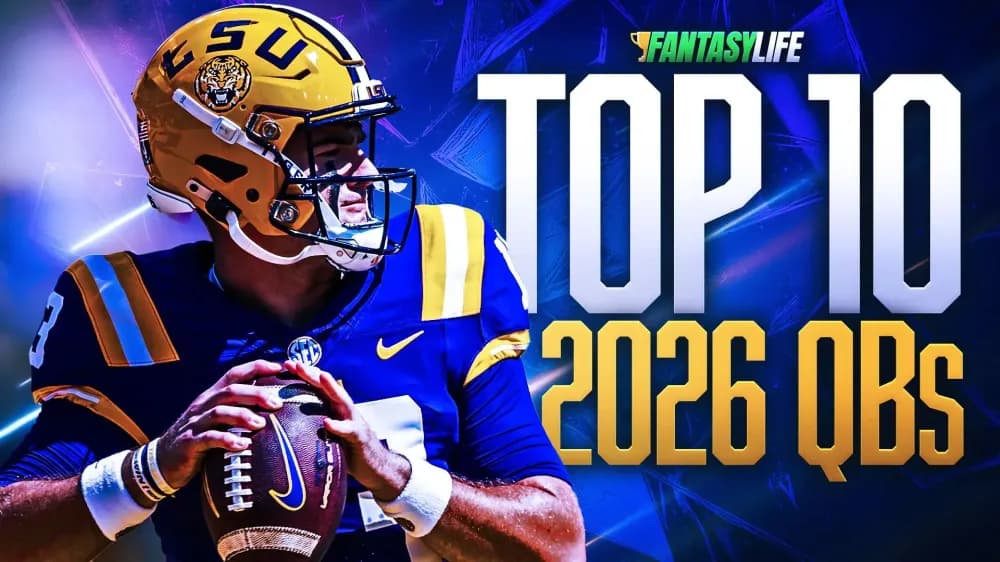
2026 NFL Draft QB Rankings: Early Look At The Top-15
Thor Nystrom breaks down who the top 15 quarterbacks for the 2026 NFL draft are, and what we should watch for during the 2025 college football season as they progress through the year.
Earlier this week, I released my first 2026 NFL Mock Draft. Early? Sure. Why? How about why not?
The next step in my early draft process is highlighting the best players at each position and what we should be watching for during their 2025 season as we get closer to the draft.
Today, here are my initial QB rankings for the 2026 NFL Draft.
The Early Top-15 2026 NFL Draft QB Rankings
1. Arch Manning | Texas | 6040/225 | rSO
I did not include Manning in my too-early 2026 mock draft because I think there’s a better shot that he returns for his senior year than declares after the season. But there’s a strong chance that Arch is going to find himself in the same scenario that uncles Peyton and Eli did after their respective true junior seasons in the SEC: Do I want to be the first overall pick, or do I want to return to school?
Arch has only thrown 95 passes in college over two years. Sixty of those passes came in back-to-back games against UL-Monroe and Mississippi State last year—two bad defenses. We’re working with a very small sample here, admittedly.
But after a recent film review of Manning’s 2024 dropbacks, it became clearer and clearer that Manning’s combination of size, athleticism, arm talent, and mechanics stand alone atop this quarterback class heading into the 2025 season.
Manning was the best quarterback on Texas’ roster last season, and the Longhorns may have ultimately won the national title in January had they pulled the plug on Quinn Ewers and handed the keys to Manning earlier in the fall.
Manning has a smooth, compact delivery. He gets the ball out quickly, and it jumps out of his hand—ample RPMs are generated with no wasted motion. Manning showed comfort working the pocket, navigating pressure, and clicking through his progressions in his brief 2024 sample.
And while Manning’s tight, repeatable mechanics have clearly been polished over the years inside the Manning quarterback conveyor belt, it’s important to note that Arch’s game is not similar to either Peyton’s or Eli’s.
He is far more athletically gifted than either of his uncles. Arch isn’t a “good athlete for a Manning" ... Arch is a legitimately awesome athlete, period. If you’ve never seen Arch play, prepare yourself for the image of a Manning ripping defenses with his legs.
Manning was reportedly clocked with a 4.6-second forty coming out of high school. Last fall against UTSA, Manning hit 20.7 miles per hour on the GPS on a 67-yard touchdown run against UTSA. Reel Analytics CEO Cory Yates said Manning’s on-field athletic metrics already rank in the top quartile of speed of all quarterbacks in the company’s database.
Arch also showed more aggression pushing the ball down the field in the sample we saw him than we associate with his uncles. The downfield could also be clearly contrasted apples-to-apples with the risk-averse checkdown/screen show we got from the Ewers-led Longhorn offense last year. When we saw Arch last year, Texas’ offense immediately changed.
Anybody who says they know what Arch Manning will become is lying to you. But it would be equally disingenuous to penalize Manning in an exercise like this due to circumstance—being stuck behind a high-dollar NIL veteran incumbent starter his first two years on campus.
If the NFL Draft were tomorrow and Manning had made himself available for it—95 career snaps or not—I firmly believe Arch would hear his name called first.
2. Sam Leavitt | Arizona State | 6020/200 | rSO
In my film review of returning draft-eligible quarterbacks for this column, Leavitt had the most impressive tape of the full-time starters. Full stop.
Leavitt has NFL arm strength all day. He throws a very tight spiral with high-end velocity. He’s a tremendous athlete who reportedly runs a high 4.4-second forty. Slippery and evasive in the pocket, Leavitt rarely panics even as free defenders barrel downhill onto his doorstep.
This is because he knows he only needs a split second and one sharp movement to evade, relying on instant acceleration to flee danger from there. Leavitt’s 73.3 PFF grade under pressure last year was one of the 2026 draft-eligible class’ best marks.
Leavitt’s average time to throw of 3.04 seconds is elevated—the average for the top-60 returning quarterbacks last year was roughly 2.7. That number is a byproduct of his prerogative to climb up on the high wire at times, because he’s so good at improvising.
The fact that Leavitt played that way and still posted a stellar pressure-to-sack ratio of 13.3% was wildly impressive. Will he need to tweak that style a bit for the next level? Of course. But it’s important to make the differentiation that, at a very young age, Leavitt is less dancing himself onto the plank to jump, and more coaxing sharks to one area so he can attack the open water they just vacated.
It’s an impressive thing for a quarterback as young as Leavitt is to play a game that can often seem like it exists on the razor’s edge but actually doesn’t. Leavitt’s 1.1% turnover-worthy play rate last year was also the lowest of any prospect on this list.
On the move, I love the way Leavitt keeps his eyes downfield, looking to take advantage of the chaos his feet create on the back-end. One cool trick of Leavitt’s is pointing his receivers into open space while he’s scrambling on the perimeter. I saw multiple explosive plays that he choreographed in the moment, sandlot style, in just this way.
He keeps his velocity on the move and retains impressive accuracy off-platform. Leavitt’s tape had some of the best on-the-move dimes that I saw of the prospects reviewed for this exercise.
Sure, there are aspects of his game that need work. Leavitt can get haphazard with his mechanics, and particularly needs to clean them up when redirecting and throwing to his left. He also needs to eliminate the two or three plays per game where he goes off-the-grid YOLO and dances his way onto a bridge to nowhere.
That said, Leavitt is not getting the credit or the respect he deserves for what he did last season and for what he’s already shown as an NFL prospect. As a redshirt freshman, Leavitt led Arizona State to a Big 12 championship and a CFP berth. He oozes projectable traits, and he’s early on the developmental curve, with three seasons of eligibility remaining. He’s being slept on.
3. Drew Allar | Penn State | 6046/237 | SR
Though Allar was the No. 1 overall pick in my initial 2026 mock draft, he checks in as my personal QB3 heading into the season. I’ve heard all the Allar narratives these past few years. Most folks fall to one polarity or the other—they either see Allar as a no-doubt top-three overall NFL Draft pick, or as a smoke-and-mirrors byproduct of his recruiting billing.
I fall somewhere in between. Allar has been far better on the field the last two years than his detractors give him credit for—Penn State is a legitimate national title contender this year, and Allar is one of the biggest reasons why. That said, there remain more bugs that need fixing in his game than his ardent supporters readily acknowledge.
Allar has a prototypical NFL frame with a well-rounded skill set. He’s a strong runner with a projected 4.6s forty. He’s got a big arm, and he knows how to use it, beating downhill defenders with heat-ring fastballs.
Allar was done no favors by his mediocre receiving corps last year, who appeared allergic to creating separation. Penn State dramatically upgraded the receiving corps over the offseason in the portal.
He takes care of the ball, even under duress. He keeps his head about him in the pocket and has a good sense for navigating and manipulating it. I like the snap-bang decisions he makes when his time is running out.
My biggest current concern with Allar, ironically, comes in clean pockets. PSU OC Andy Kotelnicki’s system features a wide gamut of passing concepts. The ones Allar most struggles with are the quick-hitters—the timing concepts, including screens.
You’ll note issues marrying his footwork and dropback to the concept (mucking up the timing of the concept), you’ll notice sloppy footwork when he knows he doesn’t have to worry about pass-rushers, and you’ll notice hesitancy pulling the trigger until he can confirm the target is open. The latter issue is a hurdle he must overcome to become a strong anticipatory passer.
Allar’s issues are correctable. This year, playing with one of the best rosters in college football, there are no excuses for not addressing them.

4. Garrett Nussmeier | LSU | 6005/204 | rSR
Nussmeier, the son of Saints offensive coordinator Doug Nussmeier, is an undersized pocket-passing gunslinger who sees things quickly and gets the ball out very quickly. His game screams smacks of earned feel—he’s more than the sum of his parts. An excerpt from my notes while watching Nussmeier’s cutups recently:
“Very smart. Sees the field well. Consistently clicks through his progressions. Extremely good understanding of scheme and his responsibilities within the concept given the look. This super-computer understanding also gives him leeway to paint outside the numbers… knows the rules well enough to break them.”
Nussmeier is evasive in the pocket while keeping his eyes downfield, and he’s got some real gumption testing tight windows. Comfortable working in tight quarters, he’s capable of getting the ball out surrounded by bodies. Nussmeier’s aggression is a two-edged sword—it leads to explosive plays and keeps the defense on its toes, but it also gives the defense chances to flip the field on him.
As I mentioned in last week’s 2026 mock, one of the NFL’s two scouting services gave Nussmeier the highest grade of any senior prospect heading into the season. Coming out of the 2024 season, based on my live viewings of Nussmeier, that’s pretty close to where I was with at him.
But to be totally transparent: I liked Nussmeier more during those live viewings of LSU last fall than I did when revisiting his cutups recently. Nussmeier is not flattered by an apples-to-apples comparison of traits with the other names in my top-5. He has the game to potentially overcome that, but his margin for error is going to evaporate at the next level.
In my exposure to him live last year, he reminded me of a pint-sized Tony Romo. I’m going to toggle that comp back a bit after going through Nussmeier’s 2024 tape. I see Nussmeier as something between Case Keenum and Brock Purdy, an undersized, decisive passer who wins with his brains, not his tools.
5. LaNorris Sellers | South Carolina | 6020/242 | rSO
If this list were being done on upside alone, Sellers would be either QB1 or QB2. But since we have to consider the floor along with the ceiling, I’m comfortable ranking him QB5 heading into the fall.
When you watch Sellers, the first thing that jumps off the screen is the rushing utility. He’s a legitimately fearsome runner. When Sellers tucks and accelerates up the field, you absolutely see Auburn-era Cam Newton. He’s enormous, he’s fast, he’s strong, and he’s tough. He’s a terrifying proposition for defensive backs to deal with once he breaches the second level of the defense.
As a passer, Sellers has a big arm. He has a repeatable motion, and the ball shoots out of his hand with good velocity. You see at least a couple of flash throws each game.
But he has a long way to go in this area. Sellers doesn’t yet see the full field clearly, and he can be sluggish moving between his progressions. I didn’t see much anticipation in the film I reviewed—Sellers wants to confirm his target is open before firing. Sellers’ 3.3-second average time to throw last fall is a red flag.
In the SEC, Sellers can simply tuck the ball and barrel forward when he’s surprised by a post-snap coverage look, or when his first and especially second read have been erased. This fall, I would love to see him go to more effort to exhaust his options before running, and to use his feet to buy extra time as opposed to fleeing.
Sellers holds onto the ball too long, he puts the ball at risk too often—his 4.6% PFF turnover-worthy play rate is the highest of any quarterback on this list—and his decision-making can crater under duress when he’s penned in and can’t use his legs.
Lastly, he needs to work on marrying his lower-body mechanics to his upper body. This isn’t an issue every dropback. But I saw myriad examples of an unstable base causing self-inflicted accuracy or placement issues.
The jaw-dropping flash plays on film are undeniable. Sellers’ upside is tantalizing. And the good news is, with Sellers only entering his third year on campus, that he’s got time. If we see the leap this fall, Sellers is going to be a top-three overall pick in the spring. If we don’t, I would assume we’ll see Sellers back at South Carolina in 2026.
6. Cade Klubnik | Clemson | 6014/204 | SR
Klubnik took an enormous leap last fall, his second in the uptempo system run by OC Garrett Riley. A student of the game, Klubnik is now a verified expert of Riley’s RPO-heavy playbook.
He knows what he’s looking for, he’s poised and creative when things don’t go according to plan, and, under the tutelage of Riley, Klubnik has become comfortable going with the flow when he sees unexpected post-snap defensive looks, calmly changing plans mid-stream to take advantage of a new possibility.
Particularly impressive about Klubnik’s leap—he improved from a 65.7 PFF grade in 2023 to a best-in-the-FBS-of-returning QBs 89.3 in 2024—was that he did it with an injury-ravaged, mix-and-match mediocre receiving corps. Klubnik’s pass-catchers dropped 29 balls last year, the second-highest total on this list.
As with Nussmeier above, there are measurable caveats with Klubnik. Klubnik is slightly undersized. He has a good-but-not-great arm. He’s an above-average athlete, but certainly nothing close to elite.
Klubnik has a smooth, tight delivery, unloading the ball quickly. He is a nuanced thrower, altering speeds and trajectories as called for, skilled at fitting the ball between second- and third-level defenders in the intermediate sector.
He isn’t overly dangerous as a runner, in part because he’s reluctant to play bumper cars with his small frame. He is, however, skilled at buying time and making accurate throws on the run.
I used to undervalue quarterback prospects like this—college quarterbacks who were system masters but had average NFL tools. Two first-round picks from the last two classes—Bo Nix and Jaxson Dart—opened my eyes a bit in that regard. Passing concepts have become increasingly complicated at all levels, and the ability to master a system and have both a quick processor and mental fluidity is something that translates.
7. Fernando Mendoza | Indiana | 6050/225 | rJR
Mendoza has been getting steam this summer as a potential first-round pick. He certainly made a strong decision this offseason in transferring to Indiana to play for HC Curt Cignetti. Cignetti is a former quarterback who is one of the most quarterback-friendly coaches in college football, between development and opponent-specific game planning and play calling.
Mendoza is a tall pocket passer. He’s an average athlete, but he’s fluid and coordinated when rolling out, keeping his accuracy on the perimeter. Last fall, Mendoza was in the 82nd percentile outside the pocket, per PFF.
Mendoza isn’t pinpoint accurate, and he doesn’t have the biggest arm in the class, but you appreciate the nuance he’s already showing as a thrower. He does a good job leading receivers into open space, and he shields throws away from the defender’s leverage.
I enter this season with a wait-and-see “incomplete” grade on Mendoza. That’s because it was exceedingly difficult to unspool Mendoza from the utterly horrid offensive line he played behind last year at Cal. That unit was so bad that Cal went to comical lengths to scheme its offense around it—for long stretches avoiding inside runs or drawn-out downfield passing concepts.
Only 11.3% of Mendoza’s attempts traveled 20-plus air yards last fall. That wasn’t a function of Mendoza’s game—that was a pragmatic play-calling shift from the coaching staff to work around the problematic offensive line. There were games where Cal’s offense was almost exclusively quick-hit passes, games where Cal’s “running game” became designed screens and swings outside the tackles.
Because of all that, I couldn’t rank Mendoza any higher than this. But if he has first-round ability, Cignetti is probably the man to help him access it. Mendoza offers an intriguing canvas for Cignetti to work with.
The first areas to address: Getting Mendoza comfortable making decisions under duress again—he seemed to get the pocket-bailing yips more and more last fall as Cal’s offensive line sank to new lows—convincing Mendoza to stretch his arm and take more chances, and tightening/quickening his upper-body throwing mechanics.
Mendoza has an over-the-top motion, like a pitching machine, and there’s a little windmill action in his windup. His accuracy can get thrown out of whack when he tries to speed through it while forgetting his base under pressure.
8. John Mateer | Oklahoma | 6010/219 | rJR
Extremely unique player, a kinetic decision-maker with a livewire game. Tough and athletic, dangerous scrambler. Keeps defense on its toes for four quarters. Unorthodox thrower who can get the ball out from a variety of arm angles and doesn’t need a base under him to do it. Reminds me of a well-behaved Johnny Football with slightly less arm strength. Coming over from Washington State, Mateer gets a chance in the SEC to make a case to NFL evaluators that he’s a legitimate pro prospect.
Best of the rest … QBs 9-15 For The 2026
9. Sawyer Robertson | Baylor | 6030/218 | rSR
10. Carson Beck | Miami (FL) | 6037/233 | rSR
11. Behren Morton | Texas Tech | 6014/205 | rSR
12. Nico Iamaleava | UCLA | 6050/215 | rSO
13. Conner Weigman | Houston | 6030/211 | SR
14. Taylen Green | Arkansas | 6055/224 | rSR
15. Mark Gronowski | Iowa | 6020/236 | rSR

Join Our Newsletter
Trusted by 400,000+ fantasy football players. Get access to Fantasy Life's free award winning newsletter and tools, all in one step.
By registering or logging in, you agree to our Terms of Use and Privacy Policy.
Players Mentioned in this Article
 CaseKeenumQBCHI
 BrockPurdyQBSF
- PPG
- 14.64
 BoNixOQBDEN
- PPG
- 14.09
 JaxsonDartQBNYG
- PPG
- 11.61