2026 NFL Draft Quarterback Rankings: Fernando Mendoza and LaNorris Sellers are Headliners
Thor Nystrom releases his 2026 NFL Draft Rankings, a top-20 list headlined by Fernando Mendoza and LaNorris Sellers.
It's Week 8 of the 2025 College Football season, and plenty of conference races are getting plenty tight. And there have even been some games that had NFL scouts drooling (last week's Indiana-Oregon tilt was one example.
It's time to take a look at the QB rankings as we gradually make our way toward the 2026 NFL Draft. After some movement, we have a new No. 1 on the list.
2026 NFL Draft QB Rankings
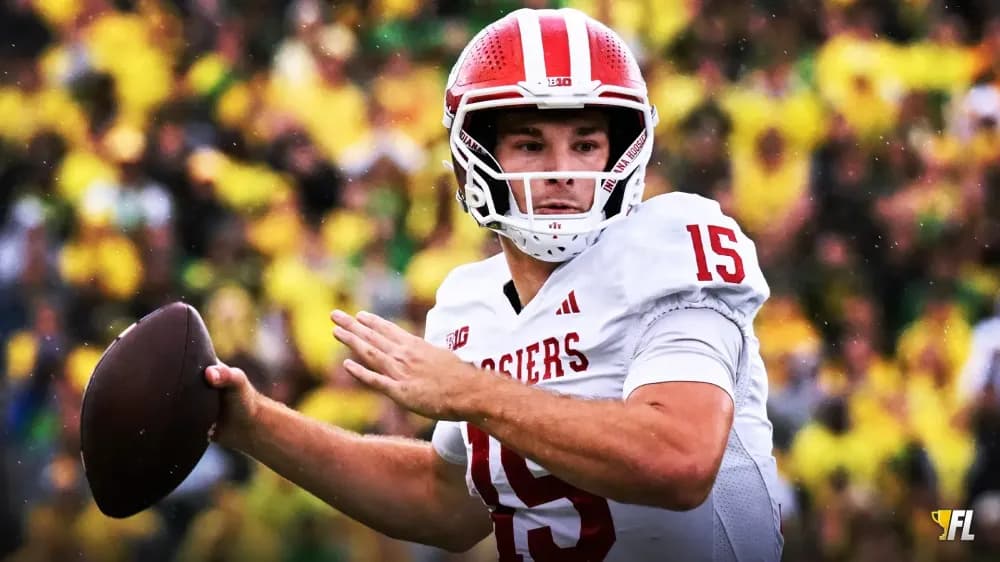
Fernando Mendoza | Indiana | 6050/225 | SR
Mendoza is a big, strapping pocket passer who excels within structure. He sees the field well, he throws on-time and he hits receivers on the hands. Mendoza has soared to the top of the quarterback board the past three weeks with three consecutive wins over Illinois, Iowa and Oregon. A Heisman frontrunner, Mendoza has posted a 17/2 TD/INT rate on 71.2% completions during Indiana’s 6-0 start. Those 17 passing touchdowns are already a career-high—Mendoza had 16 at Cal last season. Mendoza’s 9.4 aDOT is a yard higher than each of the past two seasons, and he’s still posted a career-best 78.3% adjusted accuracy mark. He’s going to draw intense interest from play callers who want their quarterbacks to run concepts as written. The biggest question with Mendoza is out-of-structure play. In 2025, Mendoza has ended 15-of-190 dropbacks outside the pocket. Mendoza went 3-for-13 on his attempts in those situations. Those 15 plays featured two sacks and two near-interceptions, and generated, in sum, 13 yards—less than a yard per play. That area is never going to be a strength of Mendoza’s, but any improvements he can show will only augment his QB1 argument.

Go FantasyLife+
Your league is unique. Your advice should be too. Get personalized tools, rankings, and projections tailored to your fantasy football league settings.
LaNorris Sellers | South Carolina | 6020/242 | rSO
Sellers is a legitimately freakish athlete, a 245-pounder who has been clocked over 22 mph on the GPS. Sellers is a vaunted rushing threat—defenses must devote extra resources to containment, thinning out back-end resources. Sellers has made strides as a passer in 2025. His adjusted accuracy is up from 74.6% to 77.9% despite throwing further down the field (aDOT up from 8.8 to 10.4). Sellers has slashed his off-target rate by nearly half in 2025. He’s not been helped by an inconsistent South Carolina receiving corps that has dropped 9.9% of Sellers’ catchable throws in 2025. That said, Sellers still holds onto the ball far too long. His 3.36-second average time to throw in 2025 is a tick higher than his career 3.31 mark, and both are legitimate red flags. Sellers needs to work on the types of quick-hit, in-structure concepts that come easily to Mendoza. Sellers also takes too many sacks, with an elevated 20.2% career pressure-to-sack rate. He’s a classic boom-or-bust prospect. Sellers isn’t there yet, but his weaknesses are theoretically fixable, while his strengths are not teachable. He has the highest ceiling in this quarterback class, and I’m not sure it’s particularly close.
Dante Moore | Oregon | 6030/210 | JR
After Moore’s star-turn performance against Penn State two weeks ago, he was viewed as the potential savior of a disappointing 2026 quarterback class. Since then, a little cold water has been thrown on the Moore Hype Train. Penn State lost to UCLA and Northwestern. Meanwhile, Moore struggled in a loss to Indiana, throwing for only 186 yards with two interceptions. Moore is blessed with accuracy and touch, and it’s encouraging to see him retain both on the move. He manages the pocket well, and has a knack for navigating it until a target becomes open. Moore owns a shiny 79.7% adjusted completion percentage. He doesn’t have a huge arm, but it’s more than adequate for the throws he’ll need to make in the NFL. On Moore’s best tape, I see some C.J. Stroud. He also has some similarities to Teddy Bridgewater at Louisville with his short-game supremacy and ease in the pocket. Everything is ahead of Moore right now. Oregon has road games against Iowa and Washington yet to go, a home game against USC, and then potentially the Big 10 title game before the CFP.
Ty Simpson | Alabama | 6020/208 | JR
Simpson is one of the least physically gifted quarterbacks on this list—he has average size, athleticism and arm strength. Simpson’s greatest strengths are field processing, decision making and touch. Mizzou HC Eli Drinkwitz provided a strong scouting report earlier this month when he spoke to the media about the game against Alabama: "[Simpson] makes very good decisions. Not easily deceived with disguise, unaffected by pressure, ability to escape. … You kind of have to pick your poison. If we play zone, he's going to pick us apart. If we blitz, he's going to stand in there, and identify the one-on-one matchup, and take it." Simpson maximizes the zip on his throws with an adherence to full-body mechanics, allowing his lower-half to do some heavy lifting in generating velocity. Simpson isn’t an elite athlete, but he senses pressure, keeps his head about him in muddy pockets, evades while keeping his eyes up, and throws with accuracy on the move. CBS Sports’ Mike Renner, a consultant for the Shrine Game, reported this week that the Shrine Game scouting staff has Simpson graded in a comparable range to Fernando Mendoza and Garrett Nussmeier.
John Mateer | Oklahoma | 6010/219 | rJR
Mateer is a dynamic dual-threat quarterback with an elastic arm and a swashbuckling style. He is a sleek athlete with 4.45 wheels, and he can throw on the move from a variety of arm angles. Mateer made a mistake in rushing back from surgery to his throwing hand against Texas. He had a disastrous showing, completed 52.6% of his passes for only 202 yards, with zero touchdowns and three interceptions. Prior to that, Mateer had only ever thrown two interceptions in a game once. I’m not going to be too punitive in this rankings update about his performance against the Longhorns, but Mateer’s margin for error to become a first-rounder in April has shrunk. That’s the bad news. The good news is that Oklahoma plays South Carolina and then five consecutive top-20 opponents to close out the regular season, giving Mateer all the primetime opportunity he could ask for to stabilize his stock. Mateer was the draft’s hottest riser through the first four weeks, dazzling in wins over Michigan and Auburn. The door is open for Mateer to re-climb draft boards down the stretch. But because Mateer is a redshirt junior, he also has the option to return to campus in 2026 if he doesn’t like where his stock sits when the regular season concludes.
Garrett Nussmeier | LSU | 6005/204 | rSR
Many names above Nussmeier on this list are high-risk, high-reward propositions. Nussmeier is more of a high-floor, modest-ceiling type. Nussmeier, the son of New Orleans Saints OC Doug Nussmeier, is an undersized gunslinger with a coach’s-son feel for the game. Nussmeier understands coverage looks, he sees the field well, and he has the courage to test tight windows. Nussmeier’s aggression is a two-edged sword—it leads to explosive plays and keeps the defense on its toes, but also can put the ball in harm’s way. Nussmeier lacks high-end arm talent, and he isn’t a great athlete. He also has health questions. In August, LSU HC Brian Kelly told the media that Nussmeier has chronic knee tendinitis that requires continual maintenance—Nussmeier aggravated that issue in camp when, per Kelly, he "probably just planted the wrong way.” In September, Kelly told the media that Nussmeier was dealing with a torso injury, specifically an abdominal strain. After the Ole Miss game, Nussmeier declined to address a direct question about his health status. Earlier this month, Nussmeier admitted to reporters that he was playing hurt, and then on Saturday he suffered a "slight" ankle sprain in a win against South Carolina.
Jayden Maiava | USC | 6040/230 | rJR
Maiava threw for over 3,000 yards to lead UNLV to a 9-5 resurgence as a redshirt freshman. He transferred to USC the following offseason, and lost a battle for the starting job to Miller Moss in camp. USC coaches eventually promoted Maiava, leading to Moss’ transfer to Louisville this past offseason. Maiava looks like a different quarterback in his second full year in Lincoln Riley’s system. He ranks No. 2 in the FBS in QB rating and is No. 1 with a 10.8 YPA. Maiava is the only quarterback in the FBS with less than 175 pass attempts and more than 1,630 passing yards—and Maiava has 1,852! Maiava has a tantalizing combination of size and athleticism—he’s very smooth on the move, both on designed concepts and when evading to extend. He has all the arm strength he needs for any NFL throw. Maiava’s mechanics have noticeably improved the past few years, but that’s the area he needs to keep progressing in. Especially when he’s run out of time, he can leave them behind. Maiava isn’t naturally accurate enough to get away with haphazard mechanics.
Cole Payton | North Dakota State | 6022/230 | rSR
The FCS darling in this year’s quarterback class, Payton is easily PFF’s No. 1-graded Division I quarterback. Last month, after a film review of Payton, I tweeted that he was “who we wanted [Tim] Tebow to be,” a 230-pound lefty with 4.5s speed who can grind out yards with his legs but also push the ball downfield. Payton has guts in the pocket, too, and will push the envelope trying to make a play, particularly when extending. Payton needs to keep working on his accuracy and placement, particularly in the intermediate sector. My other question with Payton is whether he can develop into an anticipatory passer. Payton’s athleticism is such a weapon at the FCS level that he’s become accustomed to using it as a get-out-of-jail-free card when his initial reads are not available. Because of that, he seems to have a higher burden-of-proof for unloading the ball, needing to see a target open. Nevertheless, Payton has become an intriguing sleeper to monitor in a wide-open 2026 quarterback class.
Drew Allar | Penn State | 6046/237 | SR
Earlier this week, I did a deep dive on Allar’s draft stock following his season-ending injury that you can find here.
Cade Klubnik | Clemson | 6014/204 | SR
Klubnik, who entered the season viewed as a potential first-round pick, has settled in as a Day 3 developmental prospect. Klubnik is undersized, and he has an average arm. I also don’t think he’s a fit for a traditional dropback NFL passing offense. Klubnik is very good at deciphering coverage looks pre- and post-snap, and he makes very quick decisions. He doesn’t have the howitzer to scare NFL defenses deep downfield, but Klubnik generates solid velocity and zip on his intermediate throws, including when he’s on the move. With an inconsistent running game at Clemson in 2025, more pressure has been put on Klubnik, and he hasn’t acquitted himself as well as had been hoped. This, to me, proves that Klubnik isn’t a tide-riser. But I still believe he projects as a long-term backup for a team that makes heavy use of RPO play-action, and move-the-pocket concepts.
Best of the rest…
- Carson Beck | Miami (FL) | 6037/233 | rSR
- Taylen Green | Arkansas | 6055/224 | rSR
- Josh Hoover | TCU | 6020/200 | rJR
- Brendan Sorsby | Cincinnati | 6030/230 | rJR
- Trinidad Chambliss | Ole Miss | 6000/200 | SR
- Jaden Craig | Harvard | 6022/229 | SR
- Sawyer Robertson | Baylor | 6030/218 | rSR
- Jalon Daniels | Kansas | 6003/219 | rSR
- Behren Morton | Texas Tech | 6014/205 | rSR
- Athan Kaliakmanis | Rutgers | 6020/215 | rSR

Join Our Newsletter
Trusted by 400,000+ fantasy football players. Get access to Fantasy Life's free award winning newsletter and tools, all in one step.
By registering or logging in, you agree to our Terms of Use and Privacy Policy.
Players Mentioned in this Article
 C.J.StroudQBHOU
- PPG
- 11.00
 TeddyBridgewaterQBTB
- PPG
- -0.10