Robust RB Draft Strategy For Best Ball: Three Builds With Tournament-Winning Upside
Peter Overzet breaks down how to approach a Robust RB draft strategy on Underdog Fantasy for 2025 best ball contests.
The Underdog ADP landscape has evolved significantly over the years, specifically with how the drafters approach running backs.
Some of these shifts have come from the field getting sharper and realizing that early WR firepower is a critical element to building tournament-winning teams. Other trends, however, are driven more by recency bias and drafters chasing exactly what worked the year before.
It's interesting to review the types of RB builds that have won Best Ball Mania over the years because of the variety that is represented:
- BBMI - Hyperfragile build (3 RBs early, 4 total)
- BBMII - Double Anchor RB build (2RBs early, 5 total)
- BBMIII - Double Anchor RB build (2 RBs early, 5 total)
- BBMIV - Zero RB build (No RBs early, 6 total)
- BBMV - Anchor RB build (1 RB early, 5 total)
2025 sets up as a particularly unique year for how drafters approach the RB position. On the one hand, early RBs are more expensive than they were in 2024. And yet at the same time, WR ADPs remain steady as drafters continue to prioritize them in the early rounds.
This generally results in drafters getting funneled to balanced builds with a mix of early-round RBs and early-round WRs.
This also perfectly dovetails with why the late-round QB and late-round TE strategy feels so dominant this year. You can spend your early picks on RBs and WRs, while reserving your late-round picks on all of the values at QB and TE.
But today I want to pose a question—is it viable to build Robust RB teams that are relatively unique to how the field is drafting? Are there benefits to approaching a draft with a completely different structure than what the field is gravitating toward?
Because even though drafters are perfectly willing to grab a couple of RBs early, the chalk build still skews WR-heavy.
Below, I’ll outline three recent RB-heavy teams I drafted, and you can judge whether you think there is merit to embracing some uncomfortable Robust RB teams in 2025. At the very least, it should provide you with some inspiration to push outside your RB comfort zone …
A Robust/Hyperfragile RB Build
I drafted this Poodle ($7, 20-max contest) team while out on a very hot walk in New England the other day:
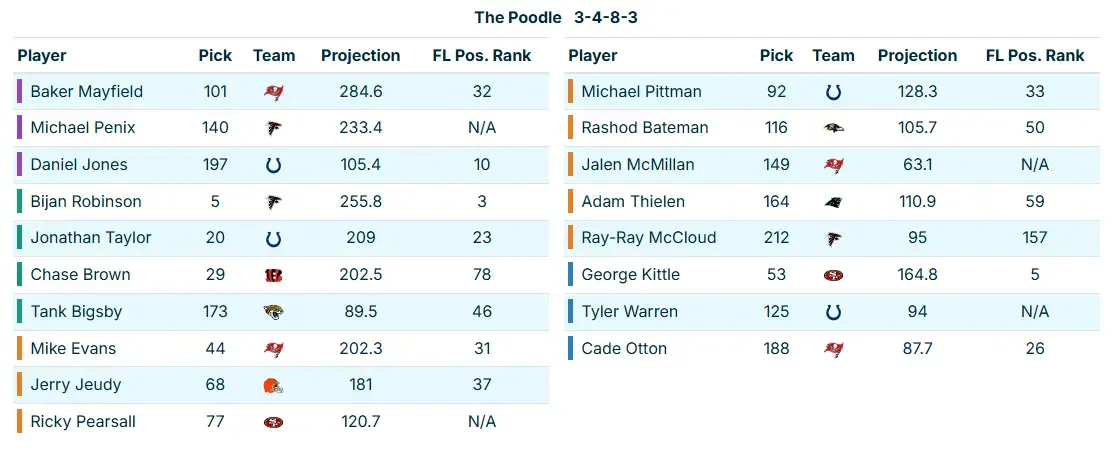
This is the exact same build that Justin Herzig utilized to win the inaugural Best Ball Mania contest—three straight RBs to start the draft and only one more tacked on for four total.
The hyperfragile strategy has gone out of vogue since then (corresponding with the year-over-year trend of WRs pushing up the board), but it is still a viable strategy if you land the plane correctly.
The key to a good hyperfragile build is to understand that you do not need more than four total RBs when you start the draft with three, and that the fourth can come extremely late. This is the ultimate “draft like you are right” exercise. This team needs Bijan Robinson, Jonathan Taylor, and Chase Brown to put up legendary seasons (or at least great ones); otherwise, it is dead on arrival.
From there, we know that we are going to need to make up for our lack of WR quality with WR quantity. I took five WRs from Round 4-10 as I tried to catch up at the position. Getting a ten pick ADP value on Mike Evans certainly helps this team look better than it would have had I not gotten an extreme faller. If I hadn’t, I likely would have passed on George Kittle for a Round 5 WR.
When I’m building out a weak WR room, I’m trying to accomplish two main things:
- A mix of young upside and proven vets
- Correlated bets with my team (and specifically, the QBs)
I steered clear of rookies on this team, but I did get some Year 2 breakout potential with Ricky Pearsall and Jalen McMillan. Guys like Jerry Jeudy, Michael Pittman, Rashod Bateman, and Adam Thielen are not my typical targets in drafts, but perfectly fit this team’s specific needs (a solid floor).
It is generally hard to go 3-QB and 3-TE on a hyperfragile build (as I’ll explain below with two other examples), but I decided that Cade Otton at pick 188 as a correlated third TE was better than a ninth random WR.
The fact that I was also able to get some nice team stacks—Bucs, Falcons, Colts, and Niners—was a bonus.
A Robust RB/Zero WR Build
I drafted this Best Ball Mania VI team on stream with a guest from the Deposit Kingdom community named Josh:
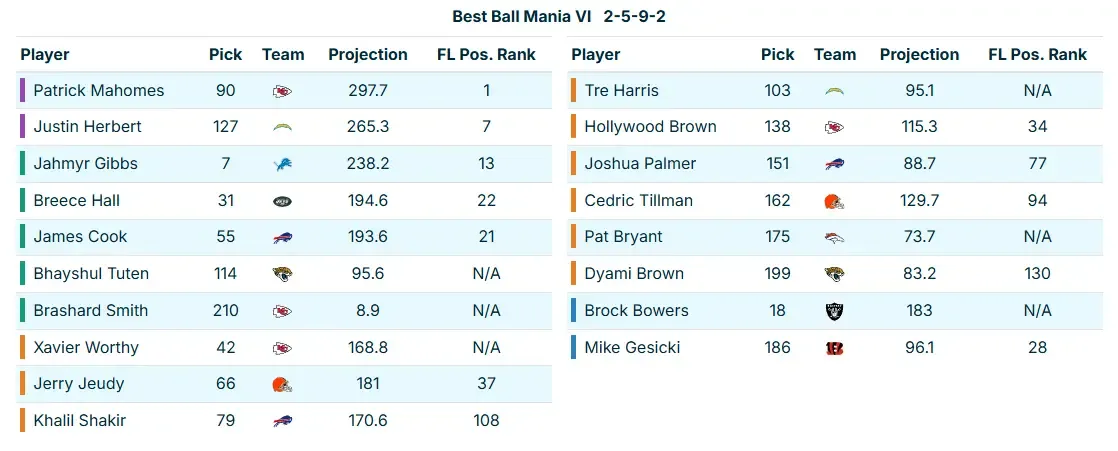
This was a unique team for me because after starting Jahmyr Gibbs (7) and Brock Bowers (18), I'm almost always taking a WR in Round 3 (in this case, I would have taken Davante Adams). However, Josh encouraged us to grab Breece Hall (31) instead. We did finally take our first WR in Round 4 (Xavier Worthy), but then continued to eschew WR when James Cook fell all the way to pick 55 in Round 5.
This is a build that legitimately makes me uncomfortable, and not something I would want to do in every contest, but using an extreme value like Cook is a very good excuse to mix things up.
To successfully pull this build off, though, we'd need to make some concessions:
- No 3-QBs or 3-TEs - Because we only had one WR through five rounds, we knew we'd need to make up for our lack of quality with a high quantity of WRs. We ended up with nine total, which meant no extra wiggle room for luxury picks at QB.
- Prioritize production at WR - When you build WR-heavy early, you can afford the luxury of taking a bunch of high upside/low floor rookie options with your later WR selections. But when you only have one, you need to proceed more cautiously. We were fortunate to land both Jeudy and Khalil Shakir in Rounds 6 and 7–two of the WRs who project the best in that range thanks to their solid target floor.
This team ultimately turned out very nice, as we were able to round out our WR room with a nice mix of upside (we still got rookies Tre Harris and Pat Bryant) and solid veterans who correlated (Hollywood Brown with Patrick Mahomes, Joshua Palmer with Cook, and Dyami Brown with Bhayshul Tuten).
Despite feeling queasy at the start, this team has the high-end RB firepower, WR depth, and correlation needed to make some noise.
A Robust Deadzone RB Build
I drafted this Best Ball Mania VI team on Monday with the BBM3 Champ, Pat Kerrane, on Best Ball Breakfast:
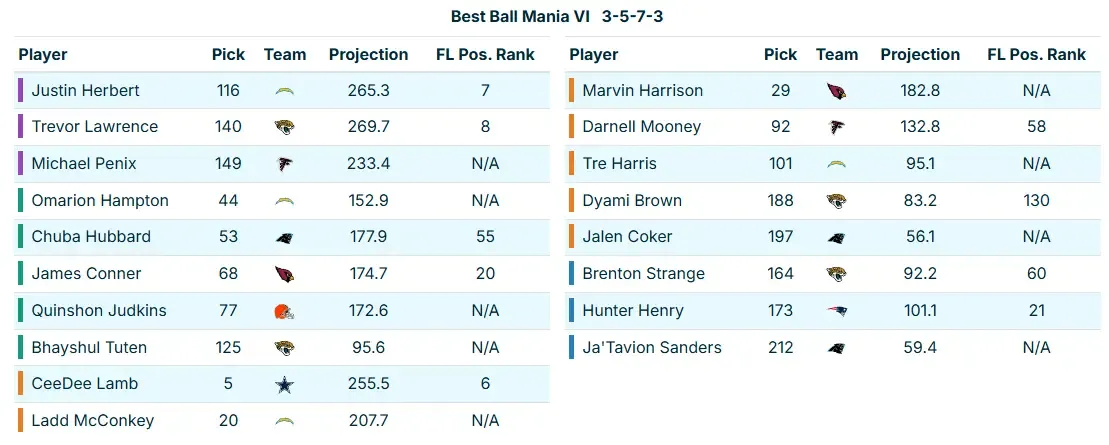
I wanted to spotlight this team because it is a different flavor of Robust RB. We actually started this draft with three straight WRs—CeeDee Lamb, Ladd McConkey, and Marvin Harrison—but then elected to take four straight RBs in Rounds 4-7:
- Omarion Hampton
- Chuba Hubbard
- James Conner (4 picks past ADP)
- Quinshon Judkins (4 picks past ADP)
The reason this is atypical and not something you'd want to execute in every draft is that historically, the RBs in this range of the draft (Rounds 4-7) are the most fragile selections.
Here's how Ben Gretch summarized it in an old post, for those not familiar:
“On a 10-year analysis, there weren’t a lot of league-winning RB seasons outside the first three rounds of drafts. In fact, RBs from Round 4 through Round 9 hit league-winning upside at about the same rate as RBs from Round 10 through Round 16.”
The big decision point in this draft was taking Judkins over Josh Downs (a move I'd generally make in this spot, knowing that WR firepower was drying up quickly), but like the first example, we used the value on Conner and Judkins to push us in the direction of a unique RB build.
Because we had three WRs up top, we had more roster construction flexibility on this team than we did with the second one, but we still had to make some adjustments to pull it off:
- Extreme Punt TE - Because we were targeting 3QBs and still needed to catch up at WR, we were forced to wait on TE until pick 164. Still, a room of Brenton Strange (stacked), Hunter Henry, and Ja’Tavion Sanders is completely fine.
- Prioritize production at WR - Funny enough, Tre Harris and Dyami Brown appear again on this team. But other than that one rookie indulgence, we knew we needed to prioritize routes and playing time, which we did with Darnell Mooney, Brown, and Jalen Coker.
Takeaways From Robust RB Strategy
- Be willing to mix up your builds with some RB-heavy starts, especially if the room gives you an extreme RB value.
- Fill out your WR room with quantity and mix up the texture of the WR profiles you are selecting (upside rookies and Year 2 guys + solid vets with more guaranteed production).
- Be patient when catching up at WRs. Try not to make more than a couple WR selections in the range from 100-140, where the value pockets are at other positions.
- Don’t forget to correlate.