
Fantasy Football Takeaways: Christian Watson Leads Utilization Report For Week 14
Welcome to the Utilization Report, where Dwain McFarland highlights his top fantasy football takeaways heading into Week 14.
Welcome to the Utilization Report, where Dwain McFarland highlights his top fantasy football takeaways heading into Week 14. Let's follow the data to identify the top waiver wire options, trade targets, upgrades, and downgrades based on what we learned in Week 13.
If you love all the sweet Utilization data below, you can access it all for yourself!
- Comparison tool
- Team-based views with game logs
- League-wide views for NFL leaders
- Customizable time periods and sample sizes
- Seasons: 2020 to 2025
Why should you care about the Utilization Score? Read this.
Get 20% off a Tier 2 FantasyLife+ subscription by using code: Dwain.
Use the Utilization Report suite of tools to dominate your league, y'all!
 1. Christian Watson is pushing for WR2 fantasy status.
Watson returned to the lineup six weeks ago after spending the first half of the season rehabbing from a Week 18 torn ACL in 2024. Over the last four games, he has worked his way into a near full-time role. Over that span, he has a 73 Utilization Score, scoring 13.8 points per game (PPG).
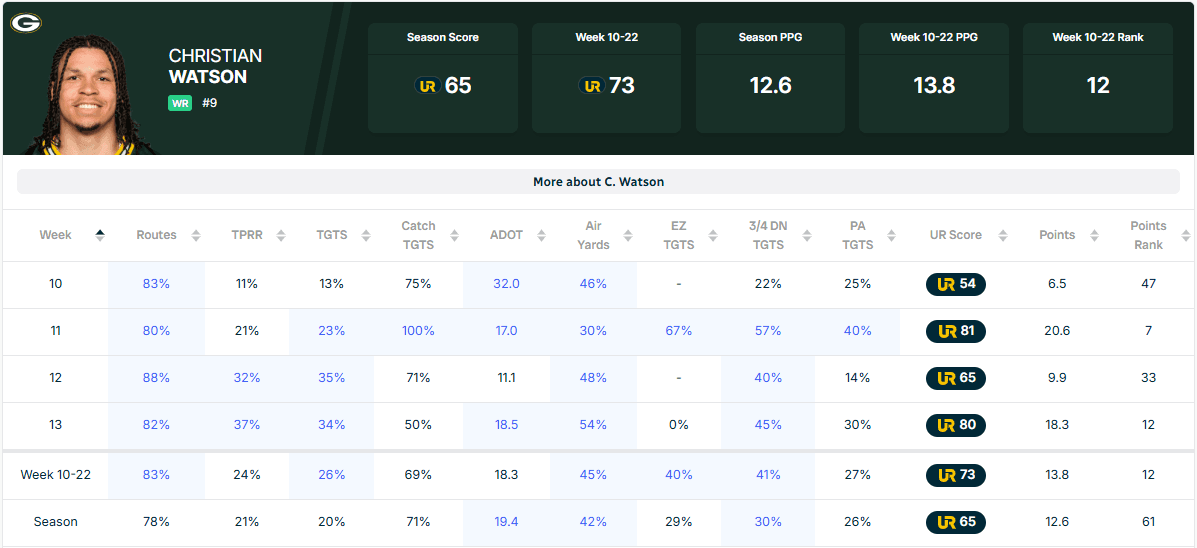
We are still dealing with a small sample, but the former second-round pick is playing some of the best football of his career. Over the last month, he registered a 2.27 yards per route run (YPRR) with a 26% target share—those are both WR1-level marks. While he continues to see deep targets with an 18.3 adot and racks up air yards (119 per game), he is also Jordan Love's favorite target on third- and fourth-down plays, with a 41% target share.
His historical Utilization Score comparisons have averaged 14.4 points, with 69% notching a top-24 finish.
- WR1 to WR12 performers: 13%
- WR13 to WR24 performers: 56%
- WR25 to WR36 performers: 29%
- WR37 to WR48 performers: 3%
The Packers' WR corps could become more crowded over the coming weeks with the return of Jayden Reed and Matthew Golden. It will be interesting to see if Watson can maintain an 80% route participation rate. He offers a skillset that no other WR on the team has—he can attack every level of the defense and can score from anywhere on the field.
Watson UPGRADES to high-end WR3 territory and offers WR2 upside.
 2. Adonai Mitchell is maximizing starter reps with the Jets.
Aaron Glenn is adamant that Mitchell was not a throw-in player in the Sauce Gardner deal. He was a player the Jets wanted. They see him as a true X receiver who can beat multiple coverages and deliver big plays. While the No. 52 overall pick from the 2024 draft has made some critical mistakes in big moments, his underlying data screams upside talent.
- Career targets per route run: 27% (WR1-worthy)
- Career yards per route run: 1.71 (WR3-worthy)
- Man TPRR in 2025: 35% (WR1-worthy)
- Man YPRR in 2025: 1.78 (WR2-worthy)
- Zone TPRR in 2025: 25% (WR1-worthy)
- Zone YPRR in 2025: 2.49 (WR1-worthy)
In two games as a starter (92% route participation rate), Mitchell has a mouth-watering 32% target share with nine per game. He has averaged a whopping 174 air yards. It's a small sample, but it should have your attention—Mitchell has an 83 Utilization Score with 15.2 PPG.
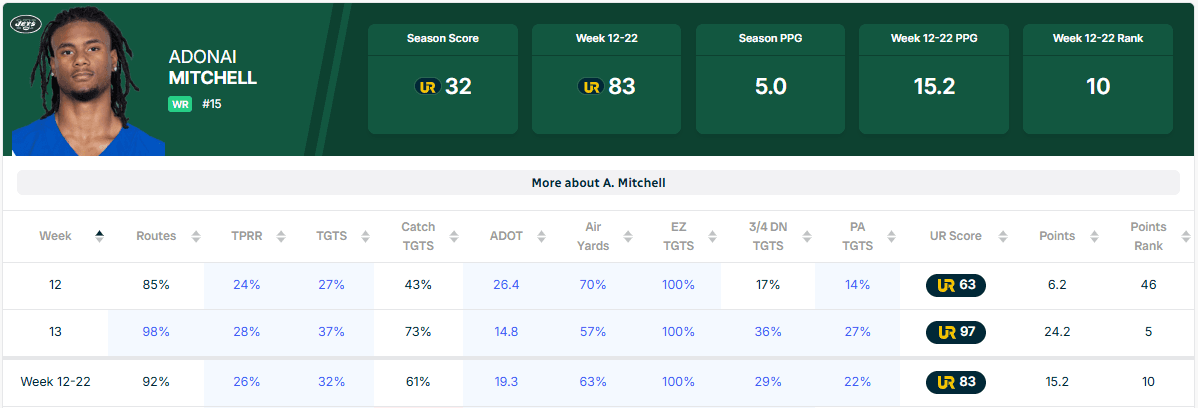
This isn't your typical flash in the pan, thanks to the significant underlying career data. That data suggests we could have a high-end player if given more playing time. For now, that is happening, and the Jets seem intent on seeing what they have.
Garrett Wilson is eligible to return in Week 15, which could create some playing time uncertainty with a rotation between Mitchell and John Metchie, who has also played well. However, the two players have very different roles—Metchie is the low aDOT option. My bet is on Metchie kicking inside to the slot duties if Wilson returns to claim the Z role.
We are operating on an extremely small sample with Mitchell, so we can look at a couple of scenarios.
Scenario 1: Mitchell's utilization with the Jets is the new reality.
In this scenario, we will use Mitchell's 83 Utilization Score from the last two games. His comparisons averaged 16.8 points per game, with 77% notching WR1 seasons.
- WR1 to WR12 performers: 77%
- WR13 to WR24 performers: 21%
- WR25 to WR36 performers: 2%
This is obviously the extreme bull case, but it does provide a glimpse of what things could look like—although unlikely—in an excellent runout for the second-year WR.
Scenario 2: Mitchell's utilization from the last two years is reality.
We have five games over the last two years where Mitchell has played a full-time role. In those games, his average Utilization Score was 62, and he averaged 11.3 points. His Utilization Score comparisons in this scenario averaged 11.9 points, with 49% finishing as top-36 WRs.
- WR1 to WR12 performers: 0%
- WR13 to WR24 performers: 9%
- WR25 to WR36 performers: 40%
- WR37 to WR48 performers: 42%
Given that the Jets have fed Mitchell 25%, 27%, and 37% target shares in three games, this scenario feels more like the bearish outlook than the midpoint.
Final takeaway: If we take the middle road, Mitchell upgrades to WR3 territory and could either climb to WR2 territory or fall to WR4 status over the coming weeks. He is available in 98% of Yahoo leagues.
 3. RJ Harvey looks like a low-end RB2 after two games.
In two games without J.K. Dobbins, Harvey has operated as Denver's RB1, but not in a dominant fashion. He has a 53% snap share, 62% attempt share, and a 9% target share on a 38% route participation rate. Over that span, he has averaged 14.6 fantasy points thanks to two touchdown runs, but his 70 Utilization Score isn't ideal.
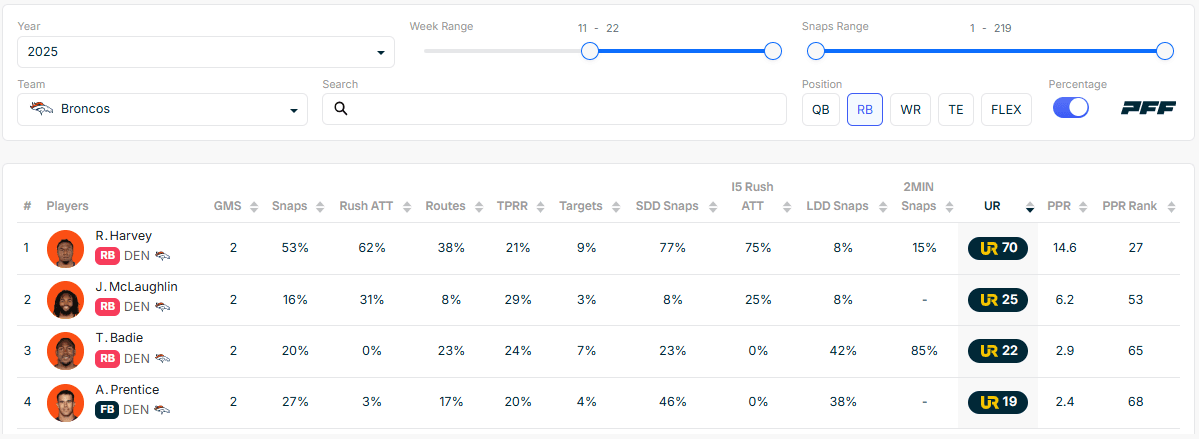
Tyler Badie continues to eat into passing-down work, taking LDD and 2-minute offense snaps while Jaleel McLaughlin operates as the No. 2 ball carrier. When you add it all up, Harvey is averaging 15.5 opportunities per game. That is a good number if Harvey is efficient, but a tad light if not. Unfortunately, the efficiency thing isn't going so hot.
- PFF Run Grade: 65.1 (49 of 58 RBs with at least 60 attempts)
- Yards per attempt: 4.0 (36 of 58)
- Yards after contact: 2.92 (34 of 58)
- 10-plus yard attempts: 3% (57 of 58)
- Missed tackles forced per attempt: 12% (51 of 58)
Nerd Note: Efficiency can be extremely fickle, and it does not correlate with more or less work across any sample size I have researched (weekly, monthly, seasonal). So, let's not freak out, y'all.
Still, to maximize his opportunities, we need some long plays from Harvey. His explosive play rate is abysmal. In Week 13, two rushing touchdowns saved the day. On a positive note, his work in the receiving game is still a plus.
- TPRR: 22% (5 of 34 RBs with at least 125 routes)
- YPRR: 1.36 (8 of 34)
While a two-game sample isn't ideal, it's all we have right now for Harvey. Based on his 70 Utilization Score, his comparisons averaged 13.7 points per game. Of his 47 comparisons, 70% performed as top-24 RBs.
- RB1 to RB12 performers: 21%
- RB13 to RB24 performers: 49%
- RB25 to RB36: 30%
The majority of his comparisons finished between RB19 and RB30 (57%). Harvey DOWNGRADES to low-end RB2 territory but still offers borderline RB1 upside.
 4. Bucky Irving led the Bucs in rushing attempts in his return.
Irving bogarted 79% of Tampa's rushing attempts in his first action since Week 4. He finished the day with 16.1 fantasy points and a 70 Utilization Score. He had 15 attempts and two targets.
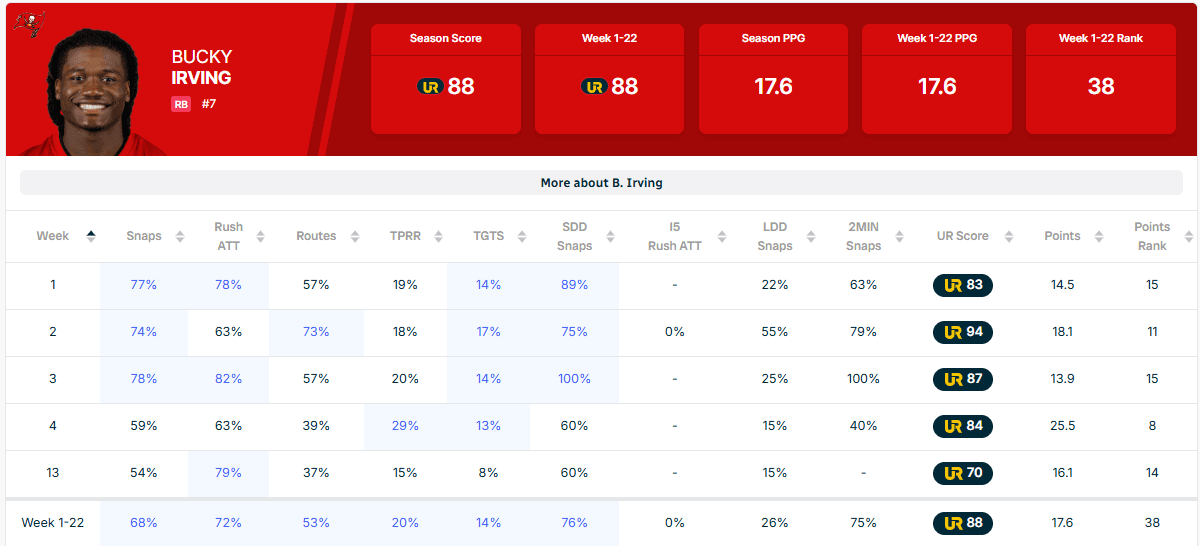
It was only his first game back, so Tampa Bay could be easing him back in, but his drop in route participation was notable. In his first three healthy games, Irving's average route participation rate was 63% with a salivating 19% target share. His dual-threat role supercharged his Utilization Score to a 90 over that span.
If he regains those duties in the coming weeks, Irving will be a high-end RB1. His early-season Utilization Score comparisons averaged 18.1 points. Of his 34 comparisons, 47% were top-six options and 38% finished between RB7 and RB12.
- RB1 to RB6 performers: 47%
- RB7 to RB12 performers: 38%
- RB13 to RB18 performers: 15%
However, if the Bucs decide to lighten Irving's role to keep him healthier by using Rachaad White on pass downs, it lowers his floor and ceiling. Irving handled a similar role over the last four games of 2024, posting a 45% route participation rate and a 71% rush share. He averaged 18.5 points, but his historical Utilization Score (80) comparisons averaged 15.5.
- RB1 to RB12 performers: 45%
- RB13 to RB24 performers: 50%
- RB24 to RB36 performers: 5%
If Irving doesn't regain his early-season passing-down role, he is a borderline RB1. If he does, he is a mid-range RB1.
 5. Chase Brown's Utilization dipped with Samaje Perine back.
The Bengals ran 80 plays against the Ravens in Week 13, which made Brown's opportunities look similar to those of previous weeks: 15 attempts and seven targets.
However, if we delve deeper into the percentages, there are red flags. From this lens, Brown's Week 13 role was drastically reduced compared to the previous three games without Perine.
- Snaps: 59% vs. 89%
- Attempts: 50% vs. 83%
- Routes: 56% vs. 82%
- Targets: 16% vs. 21%
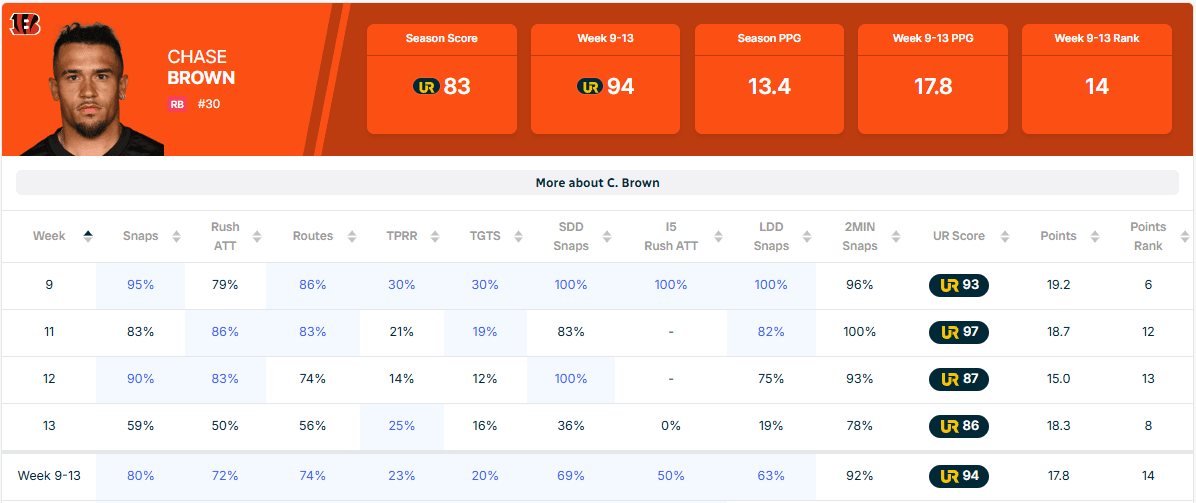
The Bengals have averaged a healthy 65 regulation plays per game with a competent QB on the field (Joe Flacco or Joe Burrow). However, they are not an 80-play-per-game unit—no team is.
This means that in a typical Bengals game, Brown's opportunities will suffer if these splits with Perine hold. And there is a chance they do. This is precisely what we say in the four games before Perine suffered the high-ankle sprain.
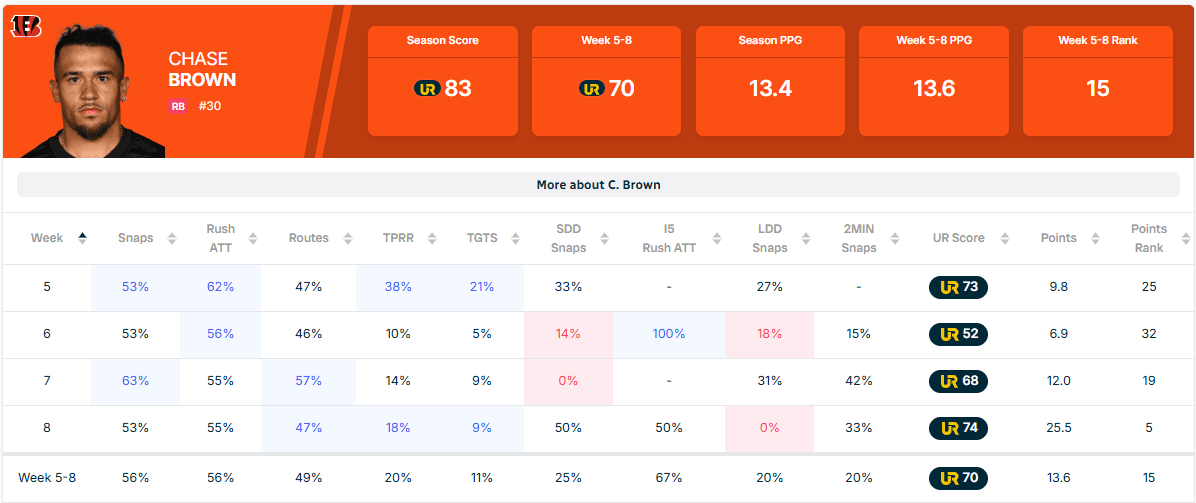
If Brown returns to this role, his historical Utilization Score comps paint a much different picture than the 17.8 points he has averaged over the last four games. They averaged 13.7 points, with only 21% notching top-12 finishes. In fact, more of the comps finished as RB3s than RB1s.
- RB1 to RB12 performers: 21%
- RB13 to RB24 performers: 49%
- RB25 to RB36 performers: 29%
Brown is due for significant regression if the Perine role is here to stay—he is a mid-range RB2 rather than a mid-range RB1.
 6. Chuba Hubbard strikes back, crippling Rico Dowdle's fantasy outlook.
In Week 12, Hubbard established a small outpost on the fringes of the Panthers' RB room, upping his snap share to 35%. That was his highest mark since Week 8. The veteran was plotting his next move and searching for a way back to the inner court of the Panthers' kingdom.
Against the Rams in Week 13, Hubbard plundered the castle, stealing 58% of the snaps, 49% of the rushing attempts, and a coveted 63% route participation rate. While Dowdle did his best to fend off the highly motivated intruder, the best he could do was retain a slight lead in rushing attempts at 51%.
Hubbard finished the day with a 78 Utilization Score and 20.4 fantasy points. Dowdle, who enjoyed a massive role from Week 9 to Week 11, plummeted to 9.9 points with a 57 Utilization Score.

It's only a one-game sample, so we can't assume Hubbard is now the Panthers' RB1. However, at a minimum, this is no longer Dowdle's backfield. The team could use a hot-hand approach or divide things so closely that we struggle to get fantasy value out of either player.
The Panthers are the most run-heavy team in the NFL with a -6% dropback rate over expected (DBOE). That means there could be plenty of attempts to go a round when game scripts are favorable. Carolina is middle of the pack in regulation plays per game at 61.2, and they are one of the slowest offenses in the NFL. Their average time remaining on the play clock in neutral situations (6.5 seconds) ranks 31st.
Hubbard UPGRADES to RB3 status, and the arrow is pointed slightly up. Dowdle DOWNGRADES to RB3 status, and the arrow is pointed down. Both still have value, but predicting which back we can trust every week could be maddening, similar to the situation in Seattle.
 7. Marvin Harrison Jr. returned to the lineup, and Michael Wilson's hot streak ended.
Last week, the wide range of outcomes for Wilson was a major topic in the Utilization Report. At the low end of the outcomes range, we discussed the possibility that Wilson's small two-game breakout was just variance. While the verdict is still out, our first data point with Harrison back wasn't good for Wilson.
His target share (20%), air yards (31%) and Utilization Score (55) all fell dramatically versus the previous two outings.
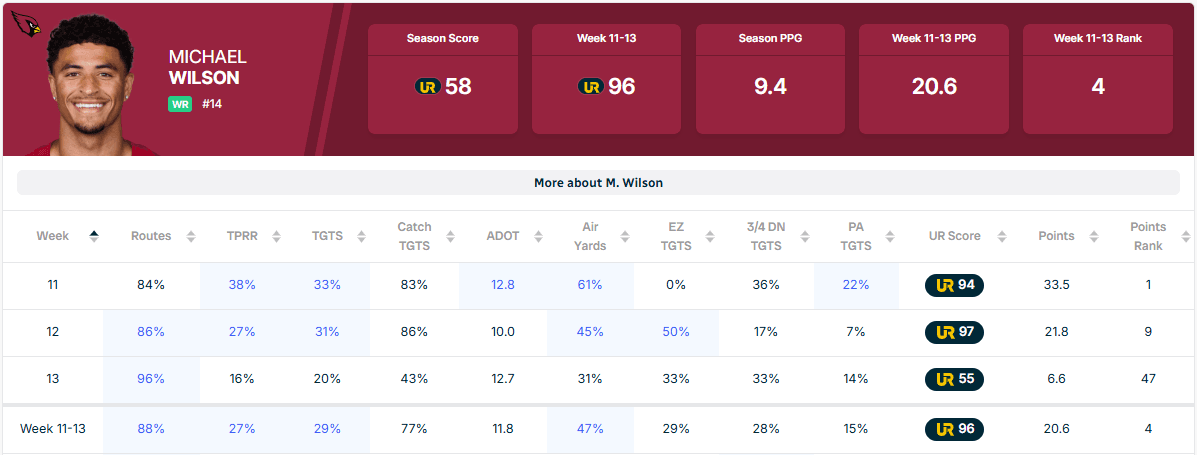
And really, it was even worse than these numbers suggest. Harrison suffered a heel injury in the third quarter that curtailed his playing time in the fourth quarter. Through the first three quarters of the game, Harrison outperformed Wilson by a significant margin.
- Harrison in the first three quarters: 12.9 points, 90% routes, 29% targets, 83 air yards
- Wilson in the first three quarters: 4.6 points, 97% routes, 10% targets, 30 air yards
This data point doesn't mean Wilson is cooked, but it also isn't good, considering his performance over the first ~2.5 years of his career before the two-week boom. Before the Harrison injury, he was on pace to post another week that looked like almost every other week in his career.
Wilson DOWNGRADES to high-end WR4 territory, but offers WR2 upside in games without Harrison.
8. Utilization Score Under & Overperformers
The Utilization Score is made up of the fantasy data points that have historically correlated the most strongly with future fantasy success. It is a similar but different concept compared to expected fantasy points. How it differs:
- Accounts for snaps and routes in addition to attempts and targets.
- Accounts for catchable targets and catchable air yards.
- The underlying role accounts for ~75% of a player's Utilization Score.
- Uses fantasy points per game (PPG) as a proxy for talent (i.e., has the player done something with their opportunities). Fantasy PPG is worth ~25% of a player's Utilization Score.
Underperformers are candidates for positive regression, making them potential buy-low targets. Overperformers are candidates for negative regression, making them sell-high options.
 Ashton Jeanty | RB | Raiders (positive regression candidate)
- Utilization Score last five weeks: 92
- Fantasy points per game last five weeks: 15.9
- Historical comps: 19.1
- RB1 to RB6: 72%
- RB7 to RB12: 20%
- RB13 to RB18: 8%
Emeka Egbuka | WR | Buccaneers (positive regression candidate)
- Utilization Score last five weeks: 73
- Fantasy points per game last five weeks: 11.7
- Historical comps: 14.4
- WR1 to WR12 performers: 13%
- WR13 to WR24 performers: 56%
- WR25 to WR36 performers: 29%
- WR37 to WR48 performers: 2%
 Saquon Barkley | RB | Eagles (positive regression candidate)
- Utilization Score last five weeks: 73
- Fantasy points per game last five weeks: 10.3
- Historical comps: 15.8
- RB1 to RB6 performers: 15%
- RB7 to RB12 performers: 40%
- RB13 to RB18 performers: 33%
- RB19 to RB24 performers: 13%
 Javonte Williams | RB | Cowboys (positive regression candidate)
- Utilization Score last five weeks: 74
- Fantasy points per game last five weeks: 11.7
- Historical comps: 14.4
- RB1 to RB12 performers: 32%
- RB13 to RB24 performers: 54%
- RB25 to RB36 performers: 15%
 Kyren Williams | RB | Rams (negative regression candidate)
- Utilization Score last five weeks: 69
- Fantasy points per game last five weeks: 15.1
- Historical comps: 13.5
- RB1 to RB12 performers: 19%
- RB13 to RB24 performers: 49%
- RB25 to RB36 performers: 32%
 Jaylen Waddle | WR | Dolphins (positive regression candidate)
- Utilization Score last five weeks: 72
- Fantasy points per game last five weeks: 12.2
- Historical comps: 14.1
- WR1 to WR12 performers: 8%
- WR13 to WR24 performers: 53%
- WR25 to WR36 performers: 29%
- WR37 to WR48 performers: 9%
9. Utilization Score Trends
Trending Up
- Devin Neal | RB | Saints: Neal has improved his Utilization Score by 18 points after notching back-to-back 72 scores with Alvin Kamara (MCL) injured. In Week 13, Neal saw expanded work on the ground with a 58% rush share and led the backfield with a 71% route participation rate. He also handled 100% of the two-minute offense and short-yardage snaps. Neal has averaged 10.5 points, but his historical Utilization Score comparisons fared significantly better at 13.9, with 55% performing as low-end RB2s or high-end RB3s. Neal is a borderline RB2 until Kamara returns.
- A.J. Brown | WR | Eagles: Brown is running hot over the last three games with the Eagles applying grease to the squeaky wheel. Over that span, he has a 97 Utilization Score, pushing his season-long score up 12 points to a 75, and averaged 24 fantasy points. He has 12, 10, and 12 targets along with 130, 92 and 147 air yards. That is a lot for an offense running only 59.3 plays per game during that timeframe. Brown is proving he can still be an alpha WR, but the same systemic questions remain—will the Eagles throw the ball enough to feed Brown in a crowded attack? They have lost two of the three games. I am not saying Brown is the reason, but coaches can get some weird stuff in their heads. My thoughts on Brown: the best path is to use his season-long Utilization Score (75), which now includes the good and the bad. His historical comparisons averaged 14.8 points, with the following range of outcomes: WR7-WR12 (22%), WR13-WR18 (30%), WR19-WR24 (25%), WR25-WR30 (16%). Brown is a mid-range WR2 with low-end WR1 upside.
- Zach Ertz | TE | Commanders: Ertz has notched target shares of 24%, 29%, and 29% over the last three contests, helping improve his Utilization Score by seven points. Over the three-game stretch, he has a 92 Utilization Score with 12.8 points per game. My gut says this is most likely a random hot streak—they happen all the time in fantasy. The Commanders' offense is more crowded with the return of Terry McLaurin. However, it is still a positive to see that Ertz has this sort of target upside still in his profile. Ertz's historical Utilization Score (77) comparisons have averaged 11.7 points. He is a low-end TE1 with mid-range TE1 upside in a pure runout.
Trending Down
- D'Andre Swift | RB | Bears: Swift played behind Kyle Monangai in Week 12 after a fumble. In Week 13, Swift returned to RB1 status, but it was of the 1A/1B variety. The splits were much tighter with Swifth handling 53% of the snaps while Monangai saw 45%. The rookie led in rushing attempts, 50% to 41%, but Swift led in route participation, 57% to 33%. Swift's Utilization Score has slipped by five points over the last four contests. Over the last two weeks, his score is 58. If this new rotation sticks, this is bad news for Swift—his historical comps have averaged 10.9 points with only 22% managing top-24 finishes. Swift DOWNGRADES to high-end RB3 status.
- Ricky Pearsall | WR | 49ers: Pearsall returned to the lineup in Week 11, but has struggled mightily versus what we saw early in the season, dragging his Utilization Score down a whopping 17 points. Over his first three healthy games, the second-year WR averaged 14.6 points with a 77 Utilization Score. In his last three games, he has 2.4 PPG with a 31 Utilization Score. With Jauan Jennings and George Kittle healthy, the second-year WR is struggling to find his place in the offense. For the season, he has a 56 Utilization Score. His comparisons averaged 10.3 points, with only 1% finishing inside the top 24. The majority were WR4 and WR5 types (81%). Pearsall DOWNGRADES to borderline WR4 status.
- Dallas Goedert | TE | Eagles: Goedert has been the forgotten man with Brown dominating targets in recent weeks. The veteran TE's Utilization Score has dropped by eight points over the last 4 weeks. The sorts of things can ebb and flow over the course of a season, which could bring Goedert back in style before the season ends. However, the Eagles' passing game is a high-variance proposition. They don't run a ton of plays and can decide to jam the run-game accelerator at the drop of a hat. Goedert's historical Utilization Score (70) comparisons averaged 10.3 points, and the majority were borderline TE1s.
10. Waiver Wire Roundup
RB
- Chris Rodriguez Jr. | Commanders: The Commanders' four-headed committee is disgusting. This is a mediocre to below-average offense, splitting rushing attempts among three RBs and a QB. Still, Rodriguez is the leader of said gross committee over the last two games with a 43% rush share. That has been worth 13 attempts and one target per game. Rodriguez has a 51 Utilization Score over that span. His historical comparisons averaged 9.3 points—right in line with the 9.8 from Rodriguez in the last two games. Rodriguez is a low-end RB3 and is available in 76% of leagues.
- Blake Corum | Rams: Kyren Williams suffered an ankle injury but was able to return to action in Week 13. Corum posted a season-high 14.1 fantasy points. The second-year back has averaged 10 rushing attempts per game since Week 7, when the team first made a concerted effort to improve his role. Corum is a premium handcuff with RB1 contingent value, available in 84% of leagues.
- Samaje Perine | Bengals: Perine stepped back into his pre-injury role in Week 13 against the Ravens. He garnered 47% of the rushing attempts and a 5% target share. Perine has RB4 stand-alone value and has established himself as the clear-cut RB2 behind Brown. If Brown missed time, Perine would be a mid-range RB2 with upside. He is available in 97% of leagues.
- Malik Davis | Cowboys: Davis made this column last week, just another reminder that he looks like the clear-cut RB2 behind Javonte Williams. Davis has shown big-play ability in recent weeks, including a 43-yard TD run against the Chiefs. Davis would enter the RB2 conversation if Williams missed time. He is available in 99% of leagues.
WR
- Adonai Mitchell | Jets: See No. 2 above. Available in 98% of leagues.
- John Metchie | Jets: Metchie only scored 5.7 points in Week 13, leading to many managers rage-cutting the veteran before waiver wires even opened. However, his underlying data was solid once again. He notched a 27% target share on a 98% route participation rate. In two games as a starter, Metchie has averaged 12.1 points with a 68 Utilization Score. It's a small sample, but his historical comparisons averaged 13.1 points with 44% finishing as WR3s. Metchie could kick inside for slot duties if Garrett Wilson returns. Metchie is a borderline WR3 with Wilson out and will be a WR5 when he returns. Metchie is available in 86% of leagues.
- Devaughn Vele | Saints: Vele is the clear-cut WR2 for the Saints with Brandin Cooks gone. Over the last three games, Vele has a 91% route participation rate, and he erupted with 23.3 points with a 93 Utilization Score in Week 13. He hogged 26% of the targets and 40% of the air yards, plus 33% of the endzone looks. The challenge: Vele has a 16% TPRR and 1.28 YPRR for his career. Those are WR5 or worse marks. Vele is a second-year player, so we have to give him some leeway, but I am leery of buying into his Week 13 performance. His Utilization Score in three games as a starter for the Saints is 60. His historical comps averaged 11.3 points. The majority (67%) finished in low-end WR3 to low-end WR4 territory. Vele is a mid-range WR4 and is available in 99% of leagues.
- Jalen Coker | Panthers: Coker has a hive following. We love the coke heads, y'all. The question is whether you should buy into his 17.4 Week 13 performance. I am hesitant. As much as I like Coker, he has a 15% target share with 35 air yards per game over the last four weeks. Even if we believe Coker's talent profile is stronger than that lousy target share because our eyes tell us otherwise, are we also buying into Bryce Young suddenly becoming a QB who can average over 225 yards per game? That is what it will take for two pass catchers to have a shot at value in this offense. Young has averaged 195 and failed to reach 200 in 8 of 11 healthy games. We need a lot to go right here. Coker's historical Utilization Score comparisons averaged 8.4 points. Coker is a WR5-6 who is available in 99% of leagues.
- Pat Bryant | Broncos: Bryant surpassed Troy Franklin for the WR2 role coming out of the Broncos' bye week. The rookie posted a 77% route participation rate and 17% target share versus 67% and 7% for Franklin. Bryant enters WR5 territory and could continue to climb with more playing time. He is available in 98% of leagues.
- Isaac TeSlaa | Lions: TeSlaa took over a full-time role, posting a 94% route participation rate with Amon-Ra St. Brown (ankle) knocked out of the game. Kalif Raymond (ankle) and Sam LaPorta (IR) were also out. TeSlaa hasn't done much this year with a terrible 6% TPRR. However, the third-round pick could get a chance to show more next weekend if St. Brown and Raymond can't go. TeSlaa would be a boom-bust WR5 option in that scenario. He is available in 99% of leagues.
TE
- Brenton Strange | Jaguars: Strange returned to the lineup in Week 12. In the last two games, he has averaged 13.9 points with a 79 Utilization Score. The third-year former second-rounder has an 18% target share and 63.5 air yards per game. Strange's comps averaged 12.3 points, with most performing as mid-range TE1s to low-end TE1s. It's a small sample, so I hedge toward the conservative side, but Strange is a young player with draft capital that could finally be ascending with playing time. Strange is a low-end TE1 who is available in 68% of leagues.
- Darren Waller | Dolphins: Waller returned to the lineup in Week 13 against the Saints. He posted a 65 Utilization Score and 6.7 fantasy points with a 15% target share. In three games with a near full-time role, Waller has averaged 11.6 points with an average Utilization Score of 71. His historical comps have been low-end TE1s or high-end TE2s, averaging 10.5 points. Waller is available in 70% of leagues.
- Harold Fannin Jr. | Browns: The Browns' passing attack is pretty, pretty, pretty gross. However, Fannin has emerged with a full-time role over the last two games with 81% and 93% route participation rates. He has 33% and 22% target shares in those contests. Fannin's historical comparisons have been low-end TE1s, but he offers mid-range TE1 upside if Shedeur Sanders improves. Fannin is a borderline TE1 and is available in 67% of leagues.
Utilization Bytes Ahead Of Week 14
Running Back
- Breece Hall | Jets: Over the last four games, Hall notched a 76% snap share and handled 72% of the rushing attempts. He collected a 50% route participation rate and a 10% target share. He has averaged 14.4 points with a 78 Utilization Score. His historical comparisons have averaged 15 points, with the majority finishing as RB2s (60%).
- Jahmyr Gibbs | Lions: In three games since the loss of LaPorta, Gibbs has a mouth-watering 26% target share. Over that span, he has averaged 28.9 points with a 96 Utilization Score.
- Jordan Mason | Vikings: Aaron Jones injured his shoulder in the third quarter of Week 13 action and didn't return. Early reports indicate it wasn't a serious injury, but Mason would take over the majority of the Vikings' early-down work if Jones misses time. Zavier Scott would work on pass downs. Mason would upgrade to low-end RB2 status if Jones misses time.
- Kareem Hunt | Chiefs: Hunt monopolized the Chiefs' backfield in Isiah Pacheco's first game back. The veteran controlled 67% of the snaps, 70% of attempts, and notched a 6% target share on a 57% route participation rate. We could see the splits with Pacheco tighten as he gets healthier, but Hunt looks like the lead option for Kansas City at the moment. Hunt is a high-end RB3.
- Kyle Monangai | Bears: Monangai has sidled up next to Swift to force a 1A/1B workload split. In Week 13, the rookie led the team with a 50% rush share and finished just behind Swift in snaps with 45% vs. 53%. Monangai has a 60 Utilization Score over the last two games with 14.9 PPG. His historical comparisons point toward negative regression without further role expansion. His comps averaged 11.4 points, with the majority finishing as RB3s (57%). Monangai is a mid-range RB3.
- Rasheen Ali | Ravens: The Bengals shoved the Ravens out of their typical game script by building a lead. With Derrick Henry's role reduced, it was Ali, not Keaton Mitchell, seeing the most significant uptick in work. Justice Hill was inactive. This could mean Ali is the backup passing-down back, while Mitchell would benefit the most in leading or close scripts as the lead ball carrier if Henry missed time. Or it could mean Ali is the RB2 rather than Hill in situations where the workload could get hefty. I lean toward the former.
Wide Receiver
- Alec Pierce | Colts: Pierce used to be the deep threat who didn't get many targets. Now he is still the deep target, but gets more than go-route looks. That has opened up more targets. Over the last four games, Pierce has averaged 6.3 targets versus 6.5 for Michael Pittman Jr. However, Pierce's Utilization Score is 70 versus 59 for Pittman because his targets have led to 111.5 air yards per game, dwarfing Pittman's 56. Pierce is a WR3 with WR2 upside.
- Chris Olave | Saints: Olave has played three games without Rashid Shaheed with Tyler Shough as the starter. Over those three games, he has an 88 Utilization Score with 17.4 points per game. He has amassed a 28% target share with 130 air yards and 1.3 endzone targets per contest. His historical comps have averaged 17 points, with 79% finishing as top-12 options. Olave is a low-end WR1.
- Jakobi Meyers | Jaguars: In three games in a full-time role with Jacksonville, Meyers has averaged 15.9 points with a 71 Utilization Score. Over that span, he has a 25% target share with 56.7 air yards per game. His historical comps averaged 14 points per game with 50% finishing as WR2s and 31% as WR3s.
- Jameson Williams | Lions: With St. Brown knocked out of the Week 13 contest, Williams exploded for 26.9 fantasy points with a juicy 90 Utilization Score. He negotiated a 40% target share (10) with 82 air yards. With Sam LaPorta also sidelined, Williams could be the centerpiece of the Lions' passing attack against the Cowboys in Week 14. Williams has four top-12 performances plus a top-24 outing in the last seven outings. Williams is a borderline WR1 in games without St. Brown.
- Jauan Jennings | 49ers: Jennings has averaged 13.9 points with a 70 Utilization Score over the last four games. He has a 25% target share with seven per contest over that stretch. The veteran WR is as healthy as we have seen this year. His historical comps averaged 13.8 points with 51% finishing inside the top-24. Another 34% were WR3s, and 15% were WR4s. Jennings is a high-end WR3.
- Rashee Rice | Chiefs: In six games, Rice has an 85 Utilization Score with 20.8 PPG, notching a 28% target share (9.8). His historical comps have averaged 17.4 with 88% finishing in the top 12. Rice is a mid-range WR1.
- Terry McLaurin | Commanders: McLaurin returned to the lineup in Week 13 and played a limited role with a 60% route participation rate. Neither that nor the vaunted Broncos pass defense could hold him down. McLaurin was targeted on 42% of his routes and finished the night with 14 targets (31%) and 228 air yards (43%), along with four endzone targets. The veteran WR notched a 95 Utilization Score with 22.6 points. McLaurin is a mid-range WR3 with WR2 upside if the Commanders' passing attack can rediscover any consistency.
- Troy Franklin | Broncos: Franklin was the WR3 coming out of Denver's bye week. Pat Bryant handled the WR2 duties, limiting Franklin to a 67% route participation rate. Franklin DOWNGRADES to WR5 status.
Tight End
- Evan Engram | Broncos: Engram posted 13.9 points in the fantasy box score in Week 13 against the Commanders. He registered a season-high 22% target share and notched his second-highest route participation rate at 69%. Engram is a mid-range TE2 but would be a TE1 with upside in a larger role.
- Isaiah Likely | Ravens: Likely scored 12.5 points against the Bengals—the No. 1 matchup for tight ends. However, his role didn't change. Likely had a 58% route participation rate and 20% target share. He isn't playing enough at this point to score consistent fantasy points. Likely is a low-end TE2 with contingent TE1 upside if Andrews were to miss any time.
Team Trends
We now have five weeks of data for most teams, making it a good time to examine team-level trends that affect fantasy production. You can find the data across all 32 NFL teams in the Team Styles tab of the Utilization Report tools.
- Redzone Drive Rate vs. Touchdowns Drive Rate: Percentage of drives that reach the red zone versus how often the team is scoring a touchdown per drive. Large deltas indicate room for positive or negative regression.
- Chiefs: 13% (44% vs. 31%)
- Saints: 12% (25% vs. 13%)
- Cardinals: 12% (35% vs. 23%)
- Chargers: 11% (24% vs. 23%)
- Texans: 11% (28% vs. 17%)
- Jaguars: 10% (33% vs. 23%)
- Dropback Over Expected (DBOE): How often teams pass the ball compared to their peers when considering the score differential over the last five weeks:
- Cardinals: 8%
- Titans: 7%
- Raiders: 6%
- Broncos: 5%
- Bengals: 5%
- Chiefs: 5%
- Rams: 4%
—— - Saints: -5%
- Ravens: -5
- Browns: -5%
- Panthers: -5%
- Dolphins: -6%
- Giants: -6%
- Jets: -6%
- Commanders: -10%
- Other notable DBOE trends:
- Bears: -4% DBOE in eight games since their bye week
- Cardinals: 6% DBOE in seven games with Jacoby Brissett as the starter
- Titans: 4% DBOE in six games under Mike McCoy
- Jaguars: -3% DBOE in five games since their bye week
- Vikings: 0% DBOE in four games since J.J. McCarthy's return
- Lions: 0% DBOE in four games with Dan Campbell calling plays
- Saints: -5% DBOE in four games with Tyler Shough as the starter
- Commanders: -7% DBOE in the last three games with Marcus Mariota as the starter
- Browns: -10% DBOE in two games with Shedeur Sanders as the starter
- Colts: 1% DBOE in two games with Daniel Jones' fibula injury
- Giants: -13% DBOE in two games under Mike Kafka (pre MNF)
- Falcons: -5% DBOE in two games with Kirk Cousins as the starter (with Drake London out)
- 49ers: -6% DBOE in two games since Brock Purdy's return
- Jets: 1% DBOE in the last two games with Tyrod Taylor
- Bengals: 8% DBOE in one game with Joe Burrow back
- Chargers: -12% DBOE in their first game after the bye with Justin Herbert nursing a hand injury
- Raiders: -2% DBOE in the first game with Greg Olson calling plays
- Neutral Playclock: Teams that are leaving more or less time on the playclock when the score is within three points (neutral situations) over the last five weeks. The NFL average is 8.3 seconds.
- Cowboys: 13.1
- Commanders: 10.9
- Giants: 10.5 (pre MNF)
- Lions: 9.9
- Chiefs: 9.8
—— - Panthers: 5.9
- Jaguars: 5.8
- Cardinals: 5.6
- Play action pass rate: Teams that are utilizing play action the most per dropback over the last five weeks, which adds value to WRs and TEs on a per-route basis in fantasy:
- Rams: 45%
- Colts: 35%
- Bears: 34%
- Dolphins: 34%
- Commanders: 32%
- Lions: 32%
- Cowboys: 31%
—— - Titans: 21%
- Jets: 21%
- Chiefs: 19%
- Saints: 19%
- Bengals: 15%

Join Our Newsletter
Trusted by 400,000+ fantasy football players. Get access to Fantasy Life's free award winning newsletter and tools, all in one step.
By registering or logging in, you agree to our Terms of Use and Privacy Policy.