2026 NFL Draft RB Rankings: Jeremiyah Love, Nicholas Singleton, and More
Thor Nystrom reveals his initial top 18 running backs in the 2026 NFL Draft class.
Today, we continue through my early analysis of the 2026 NFL Draft class as we progress toward the kickoff of both the NFL and college football seasons.
If you missed the first installments, I broke down my way-too-early 2026 NFL Mock Draft (entire first round) as well as my QB rankings for the 2026 NFL Draft.
Today, we're diving into my 2026 NFL Draft RB rankings.
Running Back Rankings For The 2026 NFL Draft
1. Jeremiyah Love | Notre Dame | 6000/210 | JR
Love is the Ashton Jeanty of the 2026 NFL Draft class.
Last season, Love averaged 7.1 yards per touch while scoring at least one touchdown in every regular season game. Love posted an absurd 187.3 elusive rating (anything above 100 is above-average) and 4.47 yards after contact (94th percentile).
Making it even more impressive: Not only did Notre Dame battle offensive line injuries last year, but the Irish had a mediocre passing attack that averaged less than 200 YPG. Defenses were free to load the box against Love. They still couldn’t stop him.
Love runs through arm tackles, and he’s got a nasty cattle-prod of a stiff arm when he needs it. Back-end defenders constantly try to take out his knees, and Love’s got a nifty pogo-stick routine to fly over them and continue running. Love finished in the 98th percentile in missed tackles forced per attempt, per PFF.
When Love gets into the second level and throttles to top speed, you have a real problem on your hands. Love was electronically timed with a 4.48-second 40-yard dash at 185 pounds coming out of high school, where he was a state-champion runner in the state of Missouri. Now up to 210 pounds, Love has been clocked in the 4.3s while on campus.
He’s an unreal athlete with a creative bent on the gridiron. Love has that neat dichotomy you look for in backs this big and explosive—both patient and sudden, with an innate feel for the exact millisecond to emphatically make that transition.
You saw this in Notre Dame’s wide-zone concepts, where Love would patiently pick down the line, waiting out the linebackers. Once they had pulled themselves down into the muck and a hole had presented itself, Love would instantly go from “Sunday stroll” to “NAS button.” In an instant, he was blurring downfield.
In the passing game, Love has reliable hands, and he’s, of course, extremely dangerous in space. Last season, Love posted a 28-237-2 receiving line with two drops.
At present time, however, he’s mostly relegated to screens, dump-offs, and swings—a story told in his -0.6 aDOT last fall. We haven’t seen him deployed out wide much—in high school, either. Love also is no better than a mediocre pass-blocker.
All that said, Love is a devastating runner who is legitimately special with the ball in his hands. And he’s money-in-the-bank reliable with the rock, having never fumbled over 234 career rushing attempts in college. Assuming health, Love is a lock first-round pick in the 2026 NFL Draft.
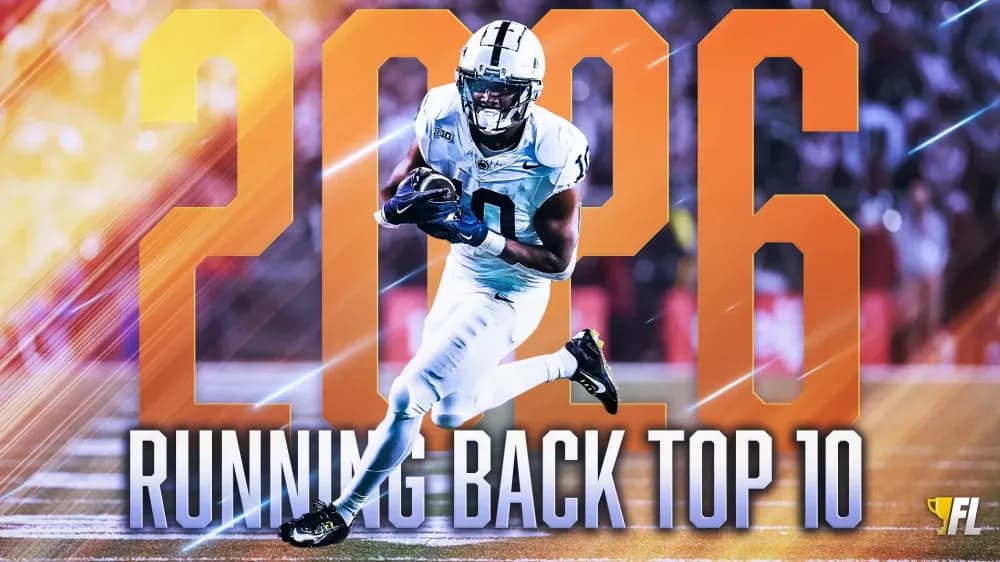
2. Nicholas Singleton | Penn State | 6003/218 | SR
Singleton, a former Gatorade National Football Player of the Year and five-star recruit, joined Love in the first round of my initial 2026 mock draft. He flashed immediately, earning 2022 Big Ten Freshman of the Year honors. Singleton spurned the NFL over the offseason to return for a chance to chase a national title in 2025.
Singleton is a one-cut, north/south runner. He isn’t looking to make defenders miss, and he rarely does outside of that initial cut. He’s not in Love’s stratosphere in the area of contact balance, and Singleton takes more flush shots because of his bullet-train-on-the-tracks ethos.
From a pure athleticism perspective, Singleton is likely to be best-in-show this coming spring. Last summer, The Athletic’s Bruce Feldman reported that Singleton has hit 23.6 mph on the GPS and runs a 4.35 forty at 228 pounds.
Feldman also reported that Singleton has posted a 4.18 shuttle and 10-1 broad. Those numbers, along with average 10- and 20-yard splits, would leave Singleton with an elite 9.98 RAS composite.
My nitpick about his style is that, while it’s high-octane explosive, it’s lacking in imagination. I think Singleton could do a better job setting up second-level defenders, sensing cutback lanes, and using his feet to become more of a moving target.
Last year, Singleton’s 33 missed tackles forced were nearly half as many as Love’s 63. Singleton’s 60.9 elusive rating was the second-lowest on this list.
Interestingly, Penn State has been explicitly vocal about improving this area of Singleton’s game this offseason. New Penn State RB coach Stan Drayton instituted drills in the spring that were designed to improve “vision, anticipation, and creativity,” per Sports Illustrated.
"With Nick, it's a lot of the open-field running and [adding] a little bit more creativity in his game," PSU HC James Franklin said in April. "He's been a guy that obviously is extremely strong, extremely explosive, extremely fast. We want to work on those open-field runs so he can get more 80-yard, 90-yard runs, which we think he is capable of getting."
Singleton is a legitimate receiving weapon—this area of his game opened my eyes during a recent film review. PSU OC Andy Kotelnicki clearly put a lot of thought last summer into how he was going to use Singleton as a pass-catcher.
Singleton was moved around the formation, and he was the primary designed read in a series of gadget plays, often with misdirection elements to usher Singleton into space.
Singleton was peppered with 52 targets, catching 41 of them. His 1.64 YPRR was tops among any RB prospect on this list. There was more nuance on his 2024 receiving film, such as well-timed chips of defensive ends before leaking into open space to free himself for a pass.
Singleton is a poor pass-blocker. Fortunately, he’s a good enough receiver that you’re rarely going to ask him to stay back for those duties.

3. Bryson Washington | Baylor | 6000/203 | rSO
Washington is an ascending talent with an interesting backstory. He was a three-sport star (basketball and track & field) who led powerhouse Franklin High School in Texas to 32-straight wins on the gridiron as a two-way star.
For whatever reason, he was undervalued as a recruit, drawing a modest three-star designation. Then he redshirted his first season on campus. So it was quite a surprise when the unknown former three-star recruit emerged from seemingly nowhere to go ballistic down the stretch in 2024, running for more than 110 yards in five of six games starting on October 19 against Texas Tech.
Washington has fun tape—he has a natural style that feels unique to him. He’s a six-foot back who runs tall. He has solid size, but he’s not physically imposing. He appears to be a solid athlete, but he’s definitely not an elite one.
But Washington grows on you the more you watch him—he tends to get the best of it because of his vision and feel, and his amalgamation of interesting traits smoothly blended.
Washington is bouncy in tight quarters, creating space for himself with his feet. He’s a glider and a slasher, not a thumper. He runs with good pace, altering tempo like a veteran. Even though he has quick feet, Washington is not a dancer—when it’s time to get north/south, he is decisive.
As the 2024 season progressed, I noticed more and more of Washington creating opportunities by sensing the cutback lane and getting into it quickly with one cut. It’s encouraging to see a young runner who is not myopic with his plan. Washington will audible in the moment and take what the defense is giving him.
Behind the line of scrimmage, you see that manifest by the way the flow of second- and third-level defenders in the distance changes his flight plan unexpectedly. This is just an innate feel for the flow of traffic. Washington will exploit the overpursuit of an outside linebacker on an inside concept by bouncing it outside to an area he knows is vacated without having to visually see it. His field sense in that regard reminded me of a quarterback—he runs himself open, as it were, by anticipating the way the playing board is about to look.
Washington’s receiving work impressed me. He’s very smooth getting out into his routes and making himself available to the quarterback. He’s got soft hands. On multiple occasions, I saw him make adjustments to reel in a ball down the field, including a slick one earlier in the season where he kept his toes in bounds near the sideline.
Baylor occasionally shifts him into the slot or boundary, often for quick-hit concepts behind multiple blockers. However, Washington did have a couple of nice plays down the field deployed in this way—you can’t simply assume he’s parking for a quick screen if you see him shift to the outside.
What’s interesting about Washington is that he’s so early on the development curve, and nowhere near what he’s going to be—and he’s already a star-caliber player. He has a projectable frame and is getting bigger.
After being listed at 203 pounds last year, I’m told he’s now up to 216. If Washington keeps his football quickness as he continues to fill out his frame, don’t be surprised to hear the name La’Veon Bell evoked.
4. Demond Claiborne | Wake Forest | 5094/192 | SR
Do you like running backs who clown defenders in space? You’re going to love Claiborne.
An undersized jitterbug, Claiborne is blessed with electric agility and home-run long speed. His ability to teleport side-to-side and then immediately throttle to top-gear can turn negative yardage into an explosive play.
When Claiborne breeches the line of scrimmage, it’s a high-speed car chase, and you need to send out an APB to every cruiser on the road to pursue him—he’s going to make the first man miss, and, from there, you need to box him in and count on your pursuit to finish the job. If Claiborne gets behind your last line of defense, put six points on the board—you aren’t catching him from behind.
There are times, watching Claiborne’s tape, when you think you’re watching LeSean McCoy at Pitt. In McCoy’s first season, the Panthers couldn’t throw, and he was ganged up on by ACC defenses—as Claiborne was last fall. That Pitt team finished 5-7 (2007), while Wake Forest went 4-8 last fall.
Claiborne was given no help by his supporting cast. Wake Forest struggled to throw the ball and had a mediocre offensive line. He managed to run for 1,049 yards and 11 TD with a 23-254-receiving line.
In the new CFB26 game, Claiborne was given a speed rating of 96. Asked about that at the ACC Media Days in July, Claiborne said he believes he’s faster than that (!). I have a 4.45 forty on Claiborne—but I would take the under on that number at the NFL Combine next spring.
Claiborne isn’t a power back, and flush shots will drop him. It’s just that it’s exceedingly difficult to square him up. He has exceptional contact balance, sliding away from off-angle tackle attempts.
The Deacs’ slow-mesh system also makes it notoriously difficult to evaluate players for the next level. This year, Claiborne moves into OC Rob Ezell’s up-tempo spread system, a scheme Claiborne’s skillset is well suited to.
Claiborne is a skilled receiver with good hands. And while Claiborne’s lack of play strength can come to the fore in pass-pro—I saw him get flattened by oncoming blitzers a few times—you can’t deny his heart. Claiborne is stepping up with a base under him to the first free defender, and he’s going to force you to go through his chest to get access to the quarterback.
If Ezell and HC Jake Dickert are smart (they are), they’re going to use Claiborne in the passing game even more this fall. Get him into space, and you make things all the more difficult for the defense.
A month ago, I was surprised to learn that both of the NFL’s scouting services had placed Day 2 grades on Claiborne. After watching his tape, I get it. I’m fascinated to see how Claiborne acclimates to his new offensive system. If he goes off in 2025, as I expect him to, he’s going to make good on those Day 2 projections.
5. Jonah Coleman | Washington | 5084/228 | SR
If Claiborne is lightning, Coleman is the thunder—fresh off the bowling ball assembly line.
Built low to the ground and rocked up with body armor, Coleman’s combination of shiftiness and power makes him a nightmare to tackle. Coleman set a new career-high with 216 touches last fall, turning them into 1,053 rushing yards and 10 TD, adding 23 receptions for 177 yards. He overcame poor offensive line play to get there.
Last fall, Coleman was sixth percentile in yards before contact. And that’s because Washington finished No. 106 in PFF run blocking. Coleman made lemonade out of a bad situation, with a 93rd-percentile finish in yards after contact.
If you combine the past two seasons, Coleman actually has slightly better yards-after-contact stats than Love. In 2023, Coleman averaged an absurd 5.09, while in 2024 he checked in with 4.34.
Coleman isn’t a burner, but he’s got more juice than you’d expect for a short-striding ball of muscle. He runs an estimated 4.51 forty, down from 4.6 coming out of high school. Coleman has remade his body in Washington’s weight room, and he doubled down on that work this offseason.
Coleman told Huskies Wire that he lost 14 pounds—going from 236 pounds to —with his body fat percentage dropping from 16.8 to 14.2. I love his burst through holes when they’re available to him—Coleman squats 545 pounds.
Washington’s offensive line is expected to be dramatically improved in 2025, so we should get to see more of Coleman’s patience, vision, and burst, as opposed to the regular evade-and-fight mode he often had to toggle into immediately after the snap in 2024.
Coleman’s efficiency on the ground speaks for itself. What adds to his NFL appeal is his passing-down contributions in a true pro-style offense. Coleman still has one year of college to go, and we can already put his pass-pro work up with anyone from the last couple of RB classes.
Listen to how Coleman talks about that phase:
"Not a lot of backs know protection going to the next level, and not a lot of colleges are teaching that, maybe a version, but we literally do NFL protections, it's just a different format," he said. "I could get on the board and show you guys. I could teach it to you guys, it's that easy, that simple, but at the end of the day, you've got to get out there and run it. It's just pretty natural, I'm a visual learner, but I could get on the board and show you guys."
Is it any surprise that Coleman is the only back in this class to have a PFF pass-blocking grade above 70 each of the last two seasons? And as a receiver, Coleman caught 49 balls over the last two seasons with only one drop.
I see Coleman as a more athletically gifted version of Texas Tech’s Tahj Brooks, who the Bengals took in Round 6 in April. Heading into the season, I’d project Coleman as a late third-rounder.
6. Jaydn Ott | Oklahoma | 5105/208 | SR
When you’re considering Jaydn Ott for the next level, my first suggestion is to discard his 2024 film. Last season, Ott suffered a high-ankle sprain in the opener against FCS UC-Davis. He attempted to play through it the following week against Auburn. Ott predictably was a non-factor (10 carries for 11 yards). From there, Ott was in-and-out of the lineup, missing three full games, while clearly not 100% in the games he did dress for.
Ott is a threshold-sized back with a thick, springy lower-half that shoots him forward from stand-still and helps him ricochet from off-angle tackle attempts. He’s a patient, one-cut back who waits for his opportunity and punches the gas. He doesn’t dance—he’s a north/south runner.
Ott has some skill as a receiver. He has long arms and soft hands. And he’s shown the ability to hit home runs if you can get him the ball in space.
We’re going to find out this fall if Ott can shake the bad habits we saw from him in 2024 when he was playing through injury behind that bad offensive line. Consistently facing immediate penetration, the flames of Ott’s patient, one-cut style, were doused.
His response was to get bounce-heavy, trying to flee danger—only he didn’t have access to his high-end speed or acceleration. Ott doesn’t often make defenders miss—he’s looking to get on a runway to access his wheels—and this rendered him an easy target to hit.
This year, you’re going to see the real Jaydn Ott again—the one we saw in 2022-2023 at Cal. He made an inspired move to transfer to Oklahoma, which is going to have the nation’s most-improved offense after importing QB John Mateer and whiz-kid OC Ben Arbuckle.
What will Ott bring to the Sooners? The explosion we saw when he rushed for 1,315 yards and 12 TD as a sophomore in 2023.
7. Darius Taylor | Minnesota | 6000/215 | JR
A productive back immediately in HC PJ Fleck’s ground-heavy offense. Over two seasons on campus, Taylor has already accrued 2,227 yards from scrimmage.
Taylor has an ideal frame from the NFL, and he’s got quick feet. He has good vision, and he marries his tempo to the situation. Taylor isn’t a bruiser, and he runs upright, but his gliding style makes it difficult to get square shots on him. That, in conjunction with his north/south ethos, converts into efficiency.
Importantly for his next-level projection, Taylor is also a very good receiver. This was a point of emphasis last offseason, and it paid huge dividends in 2024. Taylor’s 54 receptions in 2024 ranked second among all FBS returning RBs.
Taylor had the highest PFF receiving grade (78.5) of any prospect on this list. He converted an exceptional 50-of-55 targets while dropping only one. He did this while his aDOT jumped from -0.7 to 0.7, and while his usage became more diverse, with 24 snaps lined up as a wide receiver. Taylor is also one of the better pass-blockers on this list – he isn’t elite, but he’s reliable.
The negative to Taylor’s game is that he lacks high-end speed and acceleration. In the NFL, he isn’t going to be ripping off explosive runs, and his short-area margin for error is going to get smaller.
Taylor also doesn’t play special teams, a fact that is going to lose him tiebreakers on draft day to other similar RB prospects (this happened to DJ Giddens last spring, to throw out one example).
There are stylistic similarities between Taylor and former Kansas RB Devin Neal, who fell to R6 in April. Like Neal, Taylor may fall a bit because of the things he lacks. But like Neal, I expect him to hang around the NFL for a long time because of his refined skills.
8. Makhi Hughes | Oregon | 5011/210 | rJR
To replace Jordan James, Oregon went to the portal and signed Hughes, a slightly bigger version. Like James, Hughes is a tough, north/south, take-a-profit runner. Hughes is also a slightly better athlete than James, who ran a 4.55 forty at the NFL Combine. Hughes reportedly has high-4.4s speed.
Hughes reliably finds the hole and breeches it. He runs with conviction in tight quarters, and has a knack for absorbing contact without losing forward momentum. You have to swipe out his strong lower half to end the play.
Hughes will provide an NFL offense with rushing efficiency. He follows his blockers without freelancing, he is difficult to tackle, and he never fumbles (zero fumbles in 553 touches over two active seasons in college).
Hughes does, however, need to improve in the pass game to have a shot at Day 2. Despite only being used as a dumpoff/screen guy (-1.5 aDOT at Tulane), Hughes had a troubling 15.6% drop rate with a poor 0.75 YPRR.
Hughes is also not to be trusted in pass-pro. As a first-year starter in 2023, he was a sieve and got his quarterback flattened a few times. Tulane cut his pass-pro work down in 2024—Hughes was slightly better in the smaller sample, but that’s damning with faint praise.
Jordan James went in Round 5 to the 49ers in April. Hughes is a touch bigger and a touch more athletic, while James was a bit better in the pass game, and he played special teams (Hughes doesn’t). A R5 projection seems fair for Hughes, with R4 upside if we see strides in the pass game.
Best of the rest …
9. Kaytron Allen | Penn State | 5113/216 | SR
10. Rahsul Faison | South Carolina | 5107/217 | rSR
11. Quintrevion Wisner | Texas | 6000/194 | JR
12. Le'Veon Moss | Texas A&M | 5106/206 | SR
13. Jam Miller | Alabama | 5095/214 | SR
14. CJ Baxter | Texas | 6010/230 | rSO
15. Terion Stewart | Virginia Tech | 5090/220 | rSR
16. Quinten Joyner | Texas Tech | 5011/216 | JR
17. Justice Haynes | Michigan | 5010/210 | JR
18. Desmond Reid | Pittsburgh | 5056/169 | SR

Join Our Newsletter
Trusted by 400,000+ fantasy football players. Get access to Fantasy Life's free award winning newsletter and tools, all in one step.
By registering or logging in, you agree to our Terms of Use and Privacy Policy.