1.07 Draft Strategy For Fantasy Football 2025: Puka Nacua or Ashton Jeanty In Round 1?
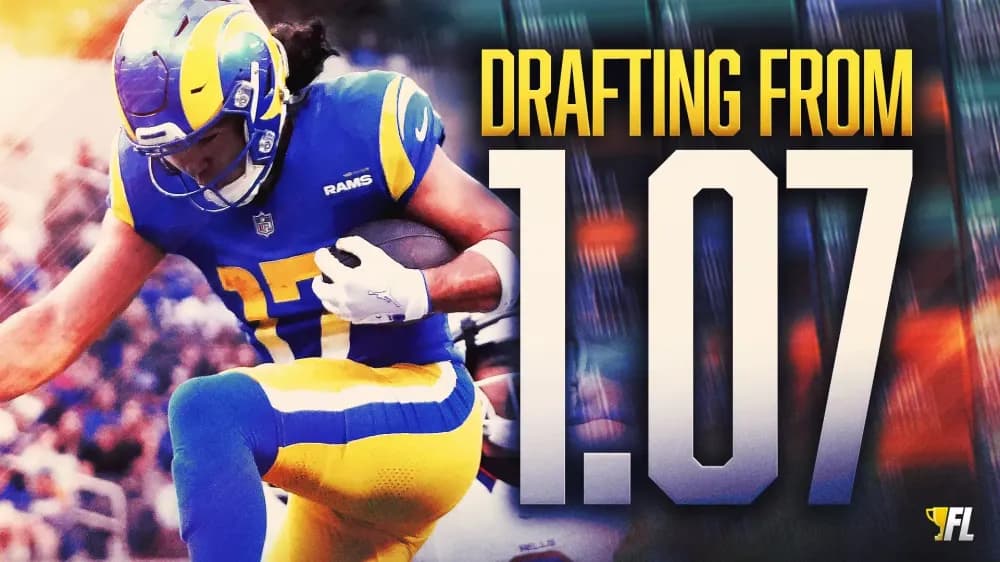
Chris Allen analyzes scenarios drafting from the 1.07 for 2025 fantasy football drafts, starting with the first round and the decision over Ashton Jeanty.
I love role-playing video games with open-world concepts.
Take Legend of Zelda: Breath of the Wild. I finally got a chance to play it during the pandemic (yeah, I know) and couldn’t get enough of it. And not just because of the storyline and homages to the previous games. But the ability to explore as you gain more skills.
Traditional RPGs have a sense of linearity to them. You fight, you grow, and keep moving. BotW gives you a chance to go back. Level 1 enemies get to feel your level 30 powers. The knowledge from before can go to what’s happening now. Drafting from the 1.07 feels the same.
We watched the first three or four spots wield their draft slot like a dungeon boss. The 1.05 had to take the leftovers. And the six-spot had to choose between injury situations. We saw how they operated. So now, with all the knowledge gained from their actions, we can approach the 1.07 as if we have all the answers.
Test the 1.07 and any other draft position for free with our Mock Draft Simulator in Draft Champion!

The First Round for the 1.07
Let’s think about the decisions that came before we got on the clock.
Ja’Marr Chase at the 1.01 should be easy relative to the other receivers. CeeDee Lamb and Justin Jefferson have question marks at QB. So we choose an asset with a secure workload and access to a ceiling. But even if you want an RB, the decision tree looks the same.
Bijan Robinson vs. Saquon Barkley comes down to risk tolerance. One has the situation, and the other has youth. However, again, we let opportunity and talent guide the way. And even if we’re sitting in the middle of the draft, the calculus is the same.
Sure, Puka Nacua and Christian McCaffrey carry their injury concerns. Yet, the allure of a top-3 performance is powerful. One more time, the product of talent and situation prevails. Now, it’s our turn. However, our leaguemates have made our job simpler.
We just watched them value targets, touches, and efficiency. Not everybody had the best team environment. As long as their skillset can transcend their surroundings, they’re worth the click. At this point in the draft, one RB sticks out.
Drafting Ashton Jeanty is like using overpowered abilities on weaker enemies. The Boise State product earned top-6 draft capital from a team with a 33-year-old rusher as the primary backup. Touches won’t be a problem. In his final year of college, Jeanty generated more yards AFTER contact than every other RB’s total yards. He already graded out as the best rookie ball carrier. His first-year outlook reflects the hype.
- (Projected) Rushing Attempts: 238.5, 7th (amongst all RBs)
- Targets: 65, 5th
- PPR Points: 246.4, 6th
Look at how easy that was. The first six picks showed us what to do. All that was left was the click of a button. But now, we’ve got a roster to build.
- Multiverse 1: Ashton Jeanty, Hero RB
- Multiverse 2: Ashton Jeanty, Balanced
- Multiverse 3: Ashton Jeanty, Late-Round QB
While I prefer to treat every first-round rusher like an anchor, there’s merit to making a strength a superpower. Besides, with the Draft Champion tool, you can simulate almost any scenario you might come across in a league. However, you’ll always have more to consider than just who you want on your team.
The Rest of the Early Rounds
First, let’s go over my general thoughts about the early rounds.
- Grab one QB or TE.
- Build starter power at the core positions.
However, this time, I want to focus on the first bullet point. The idea behind the either-or statement is to avoid creating a gap in your roster at RB or WR. Rounds 1 through 6 are our best shot at finding top-12 and top-24 talent at the positions we need the most.

I used this chart when drafting from the 1.05 to quantitatively depict the drop in production as we get to 72 overall. Last I checked, we only start one QB or TE. Meanwhile, there are a total of five or six of the other roles that have to go into starter slots. But let’s expand this concept into the real (well, simulated) world.

On the bright side, I won’t have to worry about either “onesie” position throughout the season. Both Trey McBride and Jayden Daniels are Tier 1 options. Only five WRs earned more targets per game than McBride (9.2). Daniels hit top-12 marks in dropbacks (600) and scrambles (75). Any manager would want at least one of them on their squad. But then the reality of your WR1 hits you in the face at the 42nd pick.

Marvin Harrison’s target share isn’t in question, but we’re yet to see a change in his on-field deployment. DK Metcalf’s strongest outing has been 1,303 yards back in 2020. And we had to wait 10 days into Bears training camp to hear positive reports about DJ Moore. Said another way, these aren’t WR1s.
Yes, they carry the title for the respective franchises. But their fantasy value doesn’t hold the same weight. Consequently, we’d have to play catch-up at WR in an attempt to correct the two detours. So, let’s just keep one of the elite assets.

By taking just McBride, Team 1 could secure a WR1 in both role and output (A.J. Brown), along with two of the quasi-WR1s identified before. Sure, Team 2 had a similar issue as Jaxon Smith-Njigba fell into the top slot there. But they didn’t sacrifice their opportunity cost on a QB or TE. An RB duo of Jeanty and De'Von Achane is strong. Both have top-8 outcome potentials. Either way, all three teams would need to address their gaps in the middle rounds.
Mid-Round Approach
Based on the early phase of the draft, Team 1 had a few holes to fill after conducting my mid-round assessment.
- RB2
- QB
- Depth at WR and RB
The “grab an RB2” process requires context. On the one hand, the point projection for rushers flattens out the deeper we get into the draft. But still, we should be looking to complement our starters. We don't want our season to hinge on their results. So, I took a two-pronged approach to filling the gap.
Etienne should have a starting role early in the season, but may lose work to Tank Bigsby and Bhayshul Tuten later. On the flip side, Henderson could cede work to Rhamondre Stevenson in Week 1, but he has the pass-catching upside to take over by the middle of the year. While both are projections, they address both short-term and long-term problems for my team. Combined with additional darts at the position later, I could safely enter the regular season while still needing to keep an eye on the waiver wire. But I still had to grab a QB.

Pass rate over expectation tells us how often an offense elects to pass despite the down, distance, and position dictating a run would be more optimal. Unsurprisingly, there’s a connection between PROE and passing yards. But tendencies can change year over year.
Let’s take Green Bay, for example. The Packers ranked 30th in PROE over the regular season. Jordan Love’s injury didn’t help. Josh Jacobs setting a new career-high in rushing TDs didn’t help either. However, the conservative playcalling hasn’t always been in place.
- 2023 (PROE): +1.0%
- 2024: -8.0%
Targeting Love in the late rounds isn’t a bet the Packers will turn into the Bengals. I’d take a shift to league-average. Love averaged only 29.7 dropbacks per game after he returned from injury. Aidan O’Connell had more (30.3). So did Jared Goff (33.4). Green Bay grabbing Matthew Golden in the first round at least signals they’re trying to rework their aerial attack, lending credence to Love’s viability as a late-round option.

Dallas also fell behind in PROE in ’24, and they have arguably better talent at QB and WR. So, I applied the same logic to Dak Prescott for Team 1. Plus, the squad already had George Pickens. I’ll admit the evaluation is subjective, but I’d prefer the Hero RB approach with Jeanty more times than not.
In either case, remove the names. Work back through the process taken for each team. I could swap out the Pickens-Prescott stack for Jaylen Waddle and Tua Tagovailoa. Instead of Trey McBride, I could’ve had George Kittle. The positional allocation and how each pick should inform our next is the critical takeaway. With that as a constant mantra, every roster you build from the 1.07 should have playoff potential.

Get $25 Guillotine League Credits When You Join FL+
Lorem ipsum dolor sit amet, consectetur adipiscing elit. Nunc tinciedunt, ex sit amet cursus gravida, dui mauris vulputate felis.