Three Bold Bench Calls For Week 1 Guillotine Leagues™
Thor Nystrom breaks down three players who you might assume you should start in Week 1, but carry added risk and are worthy of benching ... if you have the courage.
On a recent episode of The Chop, we were discussing starts and sits for Week 1 in Guillotine Leagues™. Below are three players—spicy ones, at that—who I would consider benching in Week 1.
Three Players To Consider Sitting In Week 1 Guillotine Leagues™
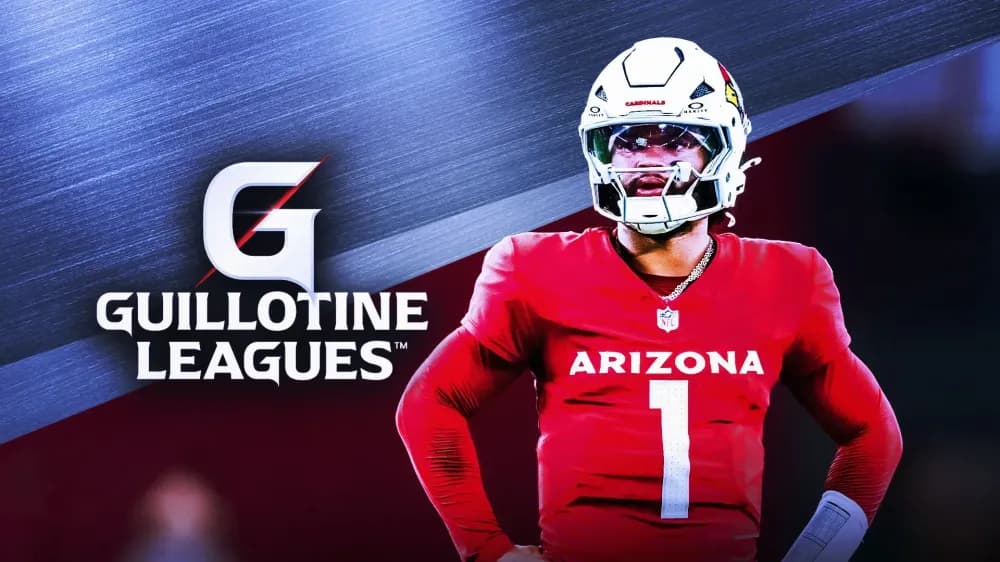
 QB Kyler Murray (at Saints)
This sneakily doesn’t set up as the ideal fantasy scenario for Murray that it might appear to be on the surface—the Cardinals are 6.5-point favorites in a game with a low total of 43. It profiles as the kind of low-scoring game where Arizona’s main offensive prerogative will be to avoid mistakes. And preventing Kyler from throwing downfield into the 2-high safety looks he struggles against might rank at the top of that list.
Murray finished QB12 in fantasy PPG in 2024 but got there in a boom-or-bust way—finishing QB15-or-lower nine times (and top-five in five games). This weekend, Murray faces a Saints’ pass defense that was good down the stretch in 2024 (top-10 passer rating allowed from Week 10 to the end of the regular season). New Saints DC Brandon Staley runs 2-high safety coverage as much as anyone in the NFL. Murray struggles against 2-high coverage, finishing QB20 in fantasy points per dropback against 2-high in 2024.
And do we really think that Murray is going to salvage his fantasy value this week on the ground? Why would he put himself in excess danger in the season-opener against one of the NFL’s worst teams? This feels like a James Conner early-and-often game for the Cardinals.
 RB Aaron Jones (at Chicago)
Since acquiring RB Jordan Mason from the 49ers in the spring, the Vikings—along with Jones himself—have publicly stated that Mason and Jones will split touches. This was necessary after Jones received a career-high 306 touches in 2024 while struggling in short-yardage situations.
Mason’s touches are going to be the meat-and-potatoes work between the tackles, along with the short-yardage and goal-line work. A good chunk of Jones’ touches will come in the pass game, where he excels and Mason struggles.
J.J. McCarthy didn’t throw to running backs a ton in college. In 2023, Michigan’s top receiving RB finished No. 4 on the team in receptions and tied for No. 4 in receiving yards (with zero receiving TD). In 2022, McCarthy’s first year as a starter, Michigan’s top receiving RB finished No. 5 in catches and No. 6 in receiving yards.
How many passes are the Vikings going to be calling for J.J. McCarthy to attempt in his first NFL start—an outdoor road night game? And how many of those will go to the running back? Of them, how much opportunity to do damage will there be? In 2024, the Bears were one of four defenses to allow 70 or fewer receptions and zero receiving TDs to opposing running backs. Jones’ carries are getting cut this season, and his path to fantasy value through the air in this game looks precarious heading in.
 TE Colston Loveland (vs. Minnesota)
Olamide Zaccheaus is the Bears’ starting slot receiver to open the 2025 season, with Luther Burden buried on the Week 1 depth chart. Loveland is listed as a starter in two-TE sets. But it would appear that he’ll lose slot snaps to Zaccheaus when the Bears aren’t in 12-personnel.
Over his three-year collegiate career, Loveland took 43.7% of snaps in the slot, 39.1% inline, and 16.4% as a boundary receiver. Kmet is a better fit for inline duties this season—Loveland will struggle to block NFL defensive ends. And while Ben Johnson used 12-personnel at the third-highest rate in the NFL last season with the Lions, that still only accounted for 32.2% of Detroit’s offensive plays.
If Loveland is only on the field for one-third of Chicago’s offensive snaps in the opener—an objectively fair estimation based on everything we know—how much damage can we expect him to do against a Vikings defense that ranked top-10 last season in fewest fantasy points allowed to opposing TE?
Tight end is one of the NFL’s slowest-developing positions, and Loveland just turned 21 after spending only three years on campus (including an injury-mired 2024). Loveland is a risky start even in deep formats this week.

Join Our Newsletter
Trusted by 400,000+ fantasy football players. Get access to Fantasy Life's free award winning newsletter and tools, all in one step.
By registering or logging in, you agree to our Terms of Use and Privacy Policy.